Digital Product Passport in Norway: EEA Status and Batteries
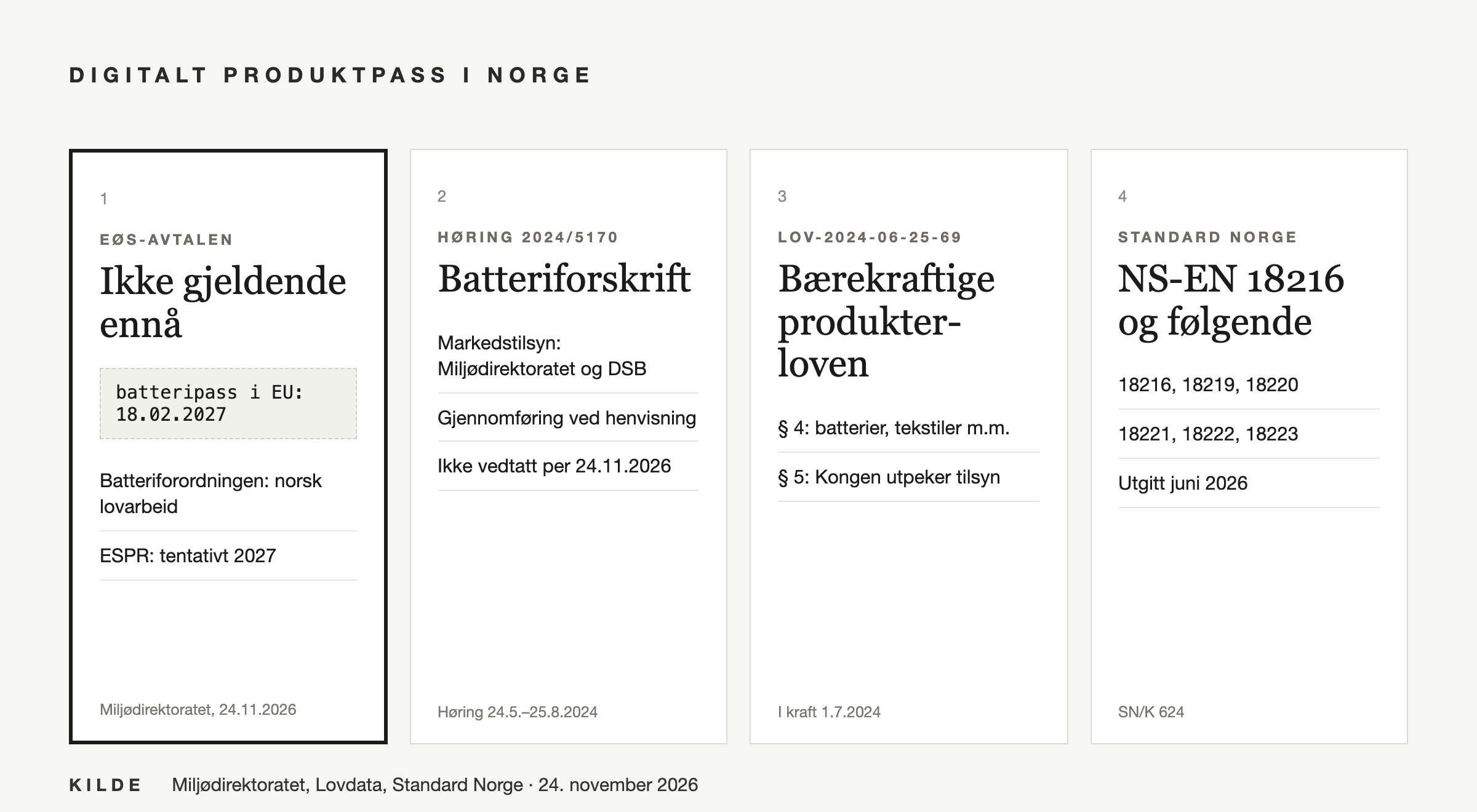
In Norway the digital product passport follows from EU law only once that law is part of the EEA Agreement and implemented in Norwegian law. On 24 November 2026 neither the Battery Regulation (EU) 2023/1542 nor the Ecodesign Regulation (EU) 2024/1781 (ESPR) applied in Norway. According to the Norwegian Environment Agency (Miljødirektoratet), the battery rules do not apply in Norway until a new Norwegian battery regulation is adopted, which depends on EEA incorporation; for ESPR the agency gives "tentatively 2027". In the EU the battery passport is required from 18 February 2027, so a Norwegian company that sells LMT, industrial or EV batteries into the EU needs it from that date. The legal basis in Norway is the Sustainable Products Act of 2024, and the passport standards are published as NS-EN 18216 and following.
Does the EU digital product passport apply in Norway?
Norway is not an EU member. EU regulations reach Norway through the EEA Agreement: the EEA Joint Committee incorporates an act, and Norway implements it in Norwegian law. Until then the act applies in the EU but not in Norway.
For both acts that carry passport rules, Miljødirektoratet's EU legislation overview shows that they do not yet apply in Norway:
- Battery Regulation (EU) 2023/1542: status "Norwegian legislative work". The overview gives "tentatively during summer 2025, when the Battery Regulation is incorporated into the EEA Agreement", and says Miljødirektoratet sent a draft consultation note and a new battery regulation to the Ministry of Climate and Environment in 2024. The agency's battery guide, read on 24 November 2026, still states that the rules do not apply in Norway before the regulation is adopted, and that this depends on incorporation into the EEA Agreement.
- Ecodesign Regulation (EU) 2024/1781: status "EU adopts", updated 11 November 2026. Under "applies to Norway" the overview says "tentatively 2027". It also states that only products meeting the product-specific ecodesign requirements can be placed on the EU/EEA market, provided the regulation and the delegated acts are incorporated into the EEA Agreement.
ESPR itself requires a passport for no product. That happens in a delegated act per product group, which in Norway must also be incorporated. The general EU timeline is in ESPR Compliance Timeline.
Batteries: what Norway has prepared
Miljødirektoratet sent a proposal for a new battery regulation (batteriforskrift) out for consultation on 24 May 2024, with a deadline of 25 August 2024 (consultation 2024/5170). According to the consultation page, the regulation implements the Battery Regulation, covers all batteries placed on the market in Norway, and includes requirements on digital battery passports. The consultation note proposes to:
- implement the requirements by reference to the EU regulation;
- give Miljødirektoratet and the Directorate for Civil Protection (DSB) responsibility for market surveillance, each in its own field;
- replace the battery provisions in chapter 2 of the Product Regulations and chapter 3 of the Waste Regulations.
The note describes the passport as the EU text does: by 18 February 2027 a digital battery passport for LMT, industrial and EV batteries, reached through a QR code and compatible with the passports under ESPR. Portable and SLI batteries are outside the passport requirement under Article 77(1) of the Battery Regulation. More in EU Battery Passport and in the DPP Academy episode on batteries.
On Lovdata, the regulations made under the Sustainable Products Act on 24 November 2026 are the Ecodesign Regulations, the Waste Regulations and the Product Regulations. A separate battery regulation is not among them.
Norwegian companies selling batteries into the EU
The EEA status decides what applies in Norway, not what applies in the EU. A battery placed on the EU market from 18 February 2027 needs a passport if it is an LMT battery, an industrial battery above 2 kWh or an EV battery, wherever it was made. For a Norwegian manufacturer selling into Sweden, Germany or any other Member State, the passport has to exist when the battery is placed on the EU market.
GS1 Norway describes the same date on its passport page: from 18 February 2027 the battery passport becomes mandatory in the EU for EV batteries, batteries for light means of transport and industrial batteries above 2 kWh.
The passport must also be registered. The EU registry opened on 20 July 2026 under Implementing Regulation (EU) 2026/1778. How registration works for batteries is in Battery Passport Registration.
The Sustainable Products Act
The Act on sustainable products and value chains (LOV-2024-06-25-69) has been in force since 1 July 2024 and belongs to the Ministry of Climate and Environment. Two sections give the powers to make regulations:
- Section 3 allows regulations implementing acts adopted under the Ecodesign Directives 2005/32/EC and 2009/125/EC and incorporated into the EEA Agreement, including requirements on documentation and on making information available.
- Section 4 allows regulations implementing EEA obligations on sustainability across the value chain for batteries, vehicles, packaging, plastics, electrical and electronic products and textiles, including documentation of sustainability aspects and making information available to the market and users.
Section 5 leaves it to the King to decide who the supervisory authority is. We found none named for ESPR passports on 24 November 2026.
Textiles and the destruction ban
ESPR's ban on destroying unsold apparel, clothing accessories and footwear has applied in the EU to large enterprises since 19 July 2026 and applies to medium-sized enterprises from 19 July 2030 (Article 25 and Annex VII). Miljødirektoratet lists the ban among the new requirements of ESPR. In Norway it applies once ESPR is incorporated into the EEA Agreement and implemented.
The Commission plans to adopt the textile delegated act in the fourth quarter of 2027, and that act will fix which data a textile passport holds. What is known about textiles is in DPP Requirements for Textiles.
Timetable
| Date | What happens | Source |
|---|---|---|
| 24 May to 25 August 2024 | Consultation on a Norwegian battery regulation | Miljødirektoratet, 2024/5170 |
| 1 July 2024 | Sustainable Products Act in force | LOV-2024-06-25-69 |
| 18 July 2024 | ESPR enters into force in the EU | Regulation (EU) 2024/1781 |
| June 2026 | Six DPP standards published as NS-EN | Standard Norge |
| 19 July 2026 | Destruction ban in the EU, large enterprises | ESPR Article 25 |
| 20 July 2026 | EU digital product passport registry opens | Implementing Regulation (EU) 2026/1778 |
| 18 February 2027 | Battery passport required in the EU for LMT, industrial above 2 kWh and EV batteries | Battery Regulation Article 77(1) |
| 2027, tentatively | ESPR applies in Norway | Miljødirektoratet |
| Fourth quarter of 2027 | Planned adoption of the textile delegated act | European Commission |
NS-EN 18216 and following: the standards in Norway
Standard Norge lists six passport standards published in June 2026:
| Standard | Subject |
|---|---|
| NS-EN 18216:2026 | Data exchange protocols |
| NS-EN 18219:2026 | Unique identifiers |
| NS-EN 18220:2026 | Data carriers |
| NS-EN 18221:2026 | Data storage, archiving and data persistence |
| NS-EN 18222:2026 | APIs for passport lifecycle management and searchability |
| NS-EN 18223:2026 | System interoperability |
Norwegian experts follow the European work in the mirror committee SN/K 624 Digital product passports. On 6 July 2026 Standard Norge published a free guide to the standards, SN/GDN 18216:2026, developed with the standards bodies in Denmark, Finland and Sweden and led by the Swedish SIS. Standard Norge lists NS-EN 18239 and NS-EN 18246 as due during 2026. Which standards are cited in the Official Journal is in CEN/CENELEC DPP Standards, and how they fit together in the DPP Academy episode on the standards.
GS1 Norway writes that its members will be able to use the GTIN together with GS1 Digital Link to share digital product passports. More in GS1 Digital Link and the DPP.
What companies in Norway can do now
- Batteries sold in the EU first. If you sell LMT batteries, industrial batteries above 2 kWh or EV batteries in the EU, plan for the passport from 18 February 2027, independent of the Norwegian regulation.
- Follow the Norwegian battery regulation. It will apply in Norway once the Battery Regulation is incorporated into the EEA Agreement and the regulation is adopted. Miljødirektoratet's battery guide describes the requirements already.
- Name the standards when choosing a system. Ask for NS-EN 18216 and following by number and edition.
- Use identifiers you control. GS1 Norway points to the GTIN with GS1 Digital Link for sharing passports.
- Check what you already have. The validator checks a passport against the EN standards and the EU registry data model. A complete example is in Digital Product Passport Example.
Frequently asked questions
Does the digital product passport apply in Norway?
Not yet as Norwegian law. The Battery Regulation and ESPR apply in Norway when they are incorporated into the EEA Agreement and implemented. According to Miljødirektoratet, ESPR is tentatively expected to apply in 2027, and the battery rules apply when the Norwegian battery regulation is adopted.
Does a Norwegian company need a battery passport in 2027?
Yes, for LMT, industrial above 2 kWh and EV batteries placed on the EU market from 18 February 2027, because the Battery Regulation applies in the EU. In Norway the obligation follows when the battery regulation is adopted.
Who will supervise the battery passport in Norway?
The 2024 consultation proposed Miljødirektoratet and DSB as market surveillance authorities, each in its own field. The regulation had not been adopted on 24 November 2026.
What is a digital product passport?
A set of data about a product, such as composition, origin, repair and recycling, reached by scanning a QR code or another data carrier on the product. More in What Is a Digital Product Passport?.
Which Norwegian standards apply to the digital product passport?
NS-EN 18216, 18219, 18220, 18221, 18222 and 18223, all of 2026, published by Standard Norge in June 2026.
Sources
- Regulation (EU) 2024/1781 (ESPR): Articles 24 and 25, Annex VII. EUR-Lex
- Regulation (EU) 2023/1542 (Battery Regulation): Article 77(1). EUR-Lex
- Commission Implementing Regulation (EU) 2026/1778 on the digital product passport registry. EUR-Lex
- Miljødirektoratet, EU legislation: the Battery Regulation. Miljødirektoratet
- Miljødirektoratet, EU legislation: the Ecodesign Regulation, updated 11 November 2026. Miljødirektoratet
- Miljødirektoratet, Battery guide: importing, producing and selling batteries. Miljødirektoratet
- Miljødirektoratet, Consultation on a proposal for a new battery regulation, 24 May 2024, with the consultation note. Miljødirektoratet
- Act on sustainable products and value chains, LOV-2024-06-25-69: sections 3, 4 and 5. Lovdata
- Lovdata, regulations made under the Sustainable Products Act. Lovdata
- Standard Norge, Digital product passports (DPP). Standard Norge
- Standard Norge, New guide gives an overview of the standards for digital product passports, 6 July 2026. Standard Norge
- GS1 Norway, Digital product passports. GS1 Norway
- GS1 Norway, An important step forward for digital product passports. GS1 Norway
- European Commission, Textile Apparel and the Digital Product Passport. Commission