Digital Product Passport Example: What a Passport Shows
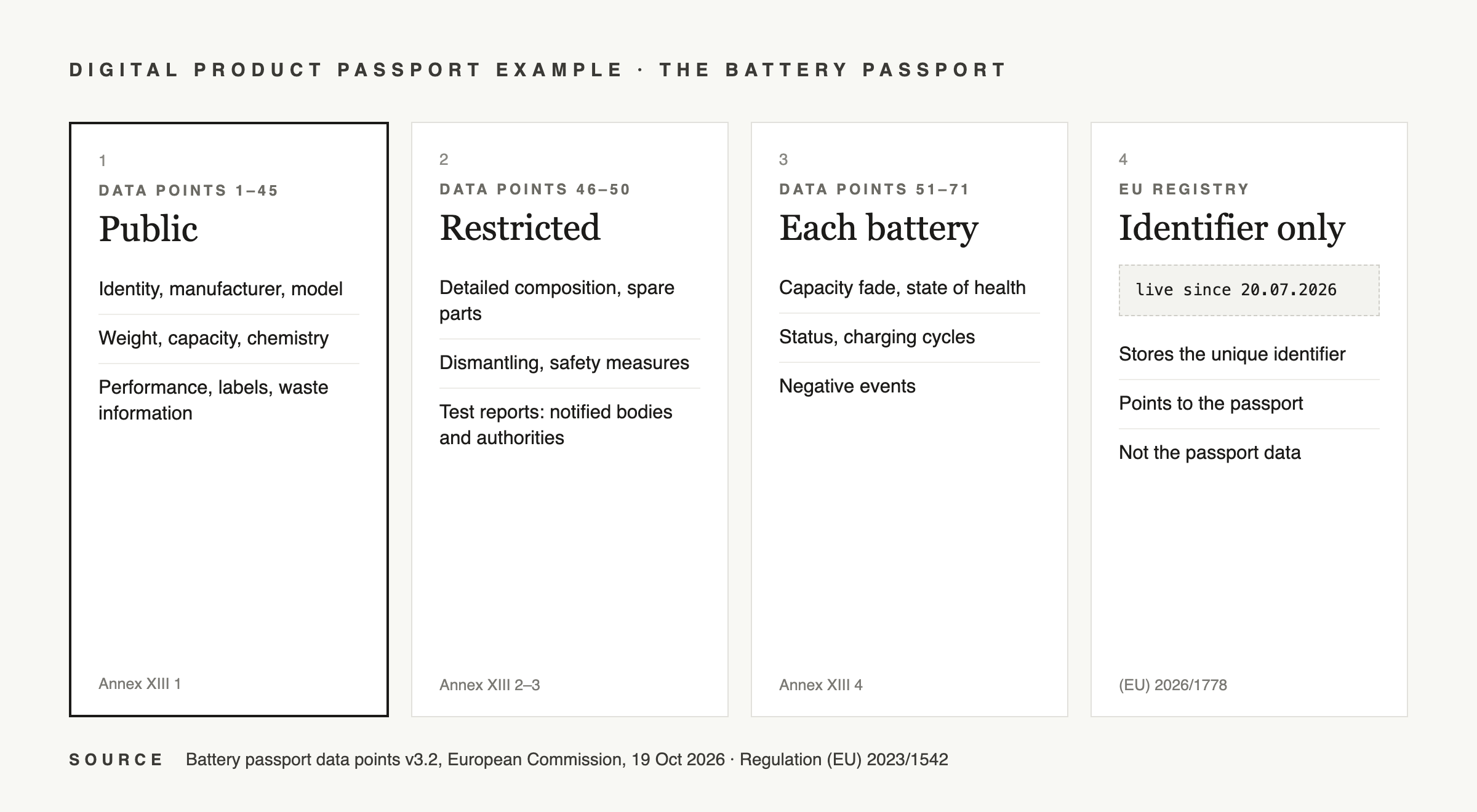
The clearest example of a digital product passport today is the EU battery passport, because it is the first one with a fixed content list. The European Commission's guide to the battery passport data points (version 3.2, 19 October 2026) lists 71 data points. Data points 1 to 45 are public and can be read by anyone who scans the QR code. Data points 46 to 49 are restricted to persons with a legitimate interest, notified bodies, market surveillance authorities and the Commission, data point 50, the test reports, to notified bodies, authorities and the Commission, and data points 51 to 71 describe the individual battery and are restricted to persons with a legitimate interest. From 18 February 2027 every LMT battery, every industrial battery above 2 kWh and every electric vehicle battery placed on the EU market needs such a passport (Battery Regulation (EU) 2023/1542, Article 77(1)).
Example 1: the battery passport, data point by data point
The table follows the Commission's guide. It shows what kind of value each group holds, not invented figures. According to the guide, the data relate to the battery model unless stated otherwise. Each battery still has its own passport: the model data repeat across the batteries of a model, while the individual battery data differ from unit to unit.
| Group | Data points (examples) | Format in the guide | Who can see it |
|---|---|---|---|
| Identity | Unique identifier, manufacturer, battery category, model and batch or serial number, place and date of manufacture | Identifier, name, code list, month and year | Public |
| Basic properties | Weight, capacity, chemistry | kg, Ah, code list | Public |
| Substances | Hazardous substances, usable extinguishing agent, critical raw materials above 0.1 % | Free text, code list | Public |
| Carbon footprint | Carbon footprint declaration and label | Format still to be set | Public, not yet to be filled |
| Recycled content | Shares of cobalt, lithium, nickel and lead recovered from waste, renewable content | % | Public, recovered shares not yet to be filled |
| Performance | Rated capacity, voltages, power capability, expected lifetime in cycles, warranty period, round trip efficiency, internal resistance | Ah, V, W, number, months, %, Ω | Public |
| Labels and documents | Markings under Article 13, EU declaration of conformity, waste information under Article 74 | Yes/No, code list, web link, free text | Public |
| Repair and dismantling | Detailed composition, part numbers for spare parts, dismantling information, safety measures | Free text, web link | Restricted |
| Test reports | Results of test reports proving compliance | Web link | Notified bodies and authorities |
| Individual battery | Capacity fade, power fade, state of health, status (original, repurposed, re-used, remanufactured, waste), number of charging cycles, negative events such as accidents | %, W, Ah, code list, number, free text | Restricted |
Ten data points are marked "not to be filled or displayed" in the guide. Two only repeat data asked for elsewhere (the material composition and the rated capacity). Seven wait for later rules: the carbon footprint declaration and label, responsible sourcing information and the shares of cobalt, lithium, nickel and lead recovered from waste. The last is the printable instructions for use, on hold pending the omnibus simplification. A passport that leaves these empty in February 2027 is therefore not incomplete.
Two details are easy to miss. The state of certified energy (data point 61) applies to electric vehicle batteries only. And the passport of a repurposed or remanufactured battery is a new passport, linked to the passport of the original battery (Article 77(7)).
What the QR code leads to
The QR code carries the battery's unique identifier, which must follow the ISO/IEC 15459 series or an equivalent standard (Article 77(3)). A GS1 Digital Link is one way to do that. A phone that scans the code opens the public view. A market surveillance authority opens the same address and receives the restricted parts as well, after it has signed in.
The passport is not stored in the EU registry. The registry, live since 20 July 2026, stores the unique identifier and a few registration data, and points to where the passport lives. More in EU Battery Passport: Requirements and Deadlines.
Example 2: a textile passport, still without a field list
For clothing and other textiles there is no binding list yet. The delegated act under the Ecodesign Regulation (EU) 2024/1781 is expected in 2027 according to the Commission's working plan, and the fields will be set in that act. The Joint Research Centre's methodology from March 2026 sorts possible data into three levels: essential, strongly recommended and voluntary. A textile passport example today can therefore only show the likely groups:
- Identity: unique product identifier, often a GTIN in a GS1 Digital Link, and the manufacturer.
- Composition: fibre composition and substances of concern.
- Origin: where the main production steps took place.
- Care and repair: care instructions and repair information.
- End of life: sorting and recycling information.
What a textile passport will actually require is in Digital Product Passport Requirements for Textiles.
Example 3: what every ESPR passport has in common
Whatever the product, a passport under the Ecodesign Regulation has the same skeleton. It is linked to a unique product identifier, reached through a data carrier on the product, kept by the economic operator or a service provider, and its identifier is registered in the EU registry. The CEN/CENELEC standards EN 18216 to EN 18223 describe how this works technically, from the identifier to the access rights. Six of the eight are cited in the Official Journal. See CEN/CENELEC DPP standards.
The product-specific content, on the other hand, comes from each delegated act. The same skeleton therefore carries very different data: for a battery the capacity and the state of health, for a T-shirt the fibre composition.
How to check a real example
- Scan the QR code. A passport must open without an app. If the link only leads to a marketing page, it is not a passport.
- Check the identifier. Each battery must have its own. If every serial number leads to the same page, it is a model page, not a passport per battery.
- Ask for the machine-readable form. The registry and authorities read the data, they do not read a web page. Article 77(5) requires that the data can be transferred without vendor lock-in.
- Check who keeps it. The passport must remain available even after the economic operator has ceased to exist (Article 78(e)).
- Run it through a validator. The validator checks a passport against the EN standards and the registry's data model, and shows which data points are missing.
The episode Who sees what in DPP Academy explains the access levels.
Frequently asked questions
Is there an official example of a digital product passport?
The Commission has published no example passport, but it has published the content list for batteries: the battery passport data points guide, version 3.2 of 19 October 2026, with 71 data points. For other products the fields come with each delegated act.
What does a battery passport show to the public?
Data points 1 to 45: identity, manufacturer, category, weight, capacity, chemistry, hazardous substances, critical raw materials, renewable content, performance and durability, labels, the declaration of conformity and waste information. Ten of them are not to be filled or displayed in February 2027.
Who can see the rest of the passport?
Detailed composition, spare part sources, dismantling information and safety measures are restricted to persons with a legitimate interest, notified bodies, market surveillance authorities and the Commission; test reports to the last three. Who counts as having a legitimate interest is set in an implementing act under Article 77(9).
Is the passport stored in the EU registry?
No. The registry stores the unique identifier and registration data, and points to the passport. The passport itself is kept by the economic operator or a service provider acting for it.
Do textiles already have a passport example?
Not a binding one. The textile act is expected in 2027 and will set the fields. Until then the likely groups are identity, composition, origin, care and repair, and end of life.
Sources
- European Commission, Battery passport data points, version 3.2, 19 October 2026. Commission
- Regulation (EU) 2023/1542 (Battery Regulation): Articles 77(1), 77(3), 77(5), 77(7), 77(9), 78(e) and Annex XIII. EUR-Lex
- Regulation (EU) 2024/1781 (ESPR). EUR-Lex
- Commission Implementing Regulation (EU) 2026/1778 on the digital product passport registry. EUR-Lex
- European Commission, Ecodesign for Sustainable Products and Energy Labelling Working Plan 2025–2030, COM(2025) 187. EUR-Lex