Digital Product Passport in Italy: Rules and Authorities
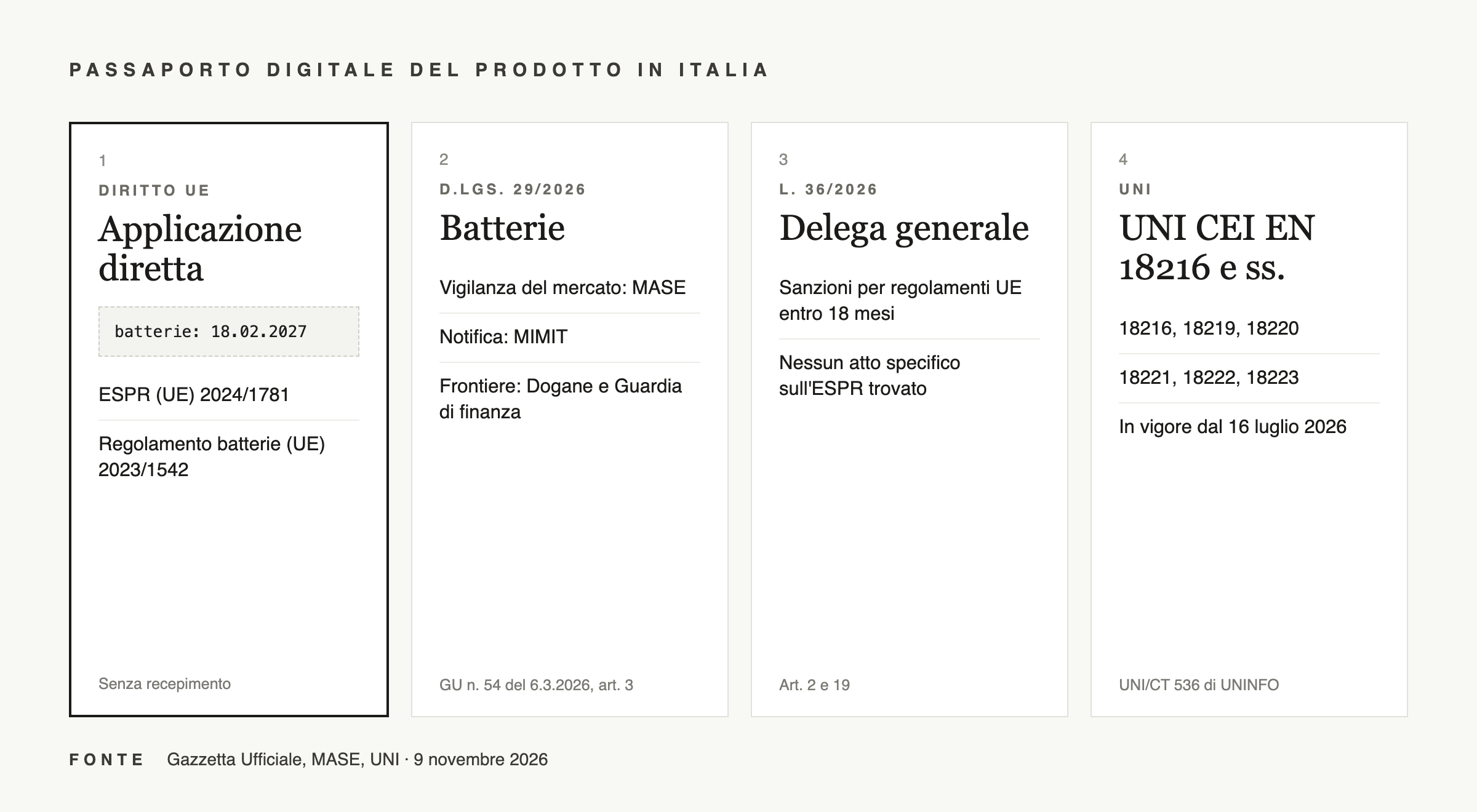
In Italy the digital product passport follows directly from EU regulations, not from an Italian law. The Ecodesign Regulation (EU) 2024/1781 and the Battery Regulation (EU) 2023/1542 apply without transposition, and the first obligation is the battery passport from 18 February 2027. Italy has adapted its own law for batteries: Legislative Decree No 29 of 10 February 2026 makes the Ministry of the Environment and Energy Security (MASE) the market surveillance authority and sets fines, though not for the passport itself. For the Ecodesign Regulation we found no Italian implementing act, only a general delegation to set penalties in the 2025 European delegation law. The passport standards have been in force as UNI CEI EN 18216 and following since 16 July 2026.
Which law requires a product passport in Italy?
A regulation of the European Union applies in every Member State on its own. Italy does not have to transpose the Ecodesign Regulation (ESPR) or the Battery Regulation for the passport to be required. ESPR itself requires a passport for no product. That happens in a delegated act per product group, and as a rule at least 18 months pass between the act entering into force and its application (Article 4(4)). The general timeline is in ESPR Compliance Timeline.
The Battery Regulation sets the date itself: from 18 February 2027 every LMT battery, every industrial battery above 2 kWh and every electric vehicle battery placed on the market needs a passport (Article 77(1)). More in EU Battery Passport: Requirements and Deadlines.
Batteries: Legislative Decree 29/2026
Italy adapted its law to the Battery Regulation with Legislative Decree No 29 of 10 February 2026, published in the Gazzetta Ufficiale No 54 of 6 March 2026 and in force since 7 March 2026. Under Article 3:
- Market surveillance lies with MASE, through its Directorate-General for product and consumption sustainability. MASE may draw on the chambers of commerce, the Guardia di Finanza and the fire service.
- The Ministry of Enterprises and Made in Italy (MIMIT) is the notifying authority for conformity assessment bodies.
- Border controls are carried out by the Customs and Monopolies Agency and the Guardia di Finanza.
Article 34 sets the fines, for example 10,000 to 150,000 euros for breaches of the labelling rules in Article 13 of the regulation, and 5,000 to 100,000 euros for breaches of the rules on substances, carbon footprint, recycled content and performance (Articles 6 to 10 and 12). The decree does not mention the battery passport or Article 77, and sets no fine specific to it. The obligation to have a passport still applies directly from the regulation.
Ecodesign: what Italy has and has not done
Member States must designate authorities and set penalties for ESPR. For Italy we found:
- No Italian act on ESPR. No legislative decree, draft or sanctions regime that names Regulation (EU) 2024/1781.
- A general delegation. Article 2 of the 2025 European delegation law (Law No 36 of 17 March 2026, in force since 9 April 2026) allows the Government, within 18 months, to set criminal or administrative penalties for breaches of EU regulations for which none exist yet. It does not name ESPR.
- A working table. MASE set up an Ecodesign working table by decree No 324 of 26 November 2024 to support the administrations implementing the regulation.
- The previous regime. Under the old ecodesign directive, Legislative Decree No 15 of 16 February 2011 named the then Ministry of Economic Development, today MIMIT, as the market surveillance authority. Whether this role carries over to ESPR has not been decided in any act we found.
The same delegation law, in Article 19, delegates the adaptation to the new Construction Products Regulation (EU) 2024/3110. It is the only place in the law that mentions the digital product passport: until the passport is fully operational, the Government is to promote the use of the latest technologies. On the construction passport itself, see Digital Product Passport for Construction Products.
Textiles: extended producer responsibility on the way
On 23 July 2026 the Unified Conference gave a favourable opinion on MASE's draft regulation on extended producer responsibility for textiles. We found no publication in the Gazzetta Ufficiale. The scheme does not create a passport, but the data it needs, such as composition and quantities placed on the market, overlap with what a textile passport will ask for. The EU textile act is expected in 2027. See Digital Product Passport Requirements for Textiles.
ENEA, the national agency for new technologies, energy and sustainable economic development, has published guidelines for traceability data in the fashion sector (CEN CWA 18291) with the passport in mind.
UNI CEI EN 18216 and following: the standards in Italy
The six European passport standards are in force in Italy as UNI CEI EN standards, edition 2026, since 16 July 2026:
| Standard | Subject |
|---|---|
| UNI CEI EN 18216:2026 | Data exchange protocols |
| UNI CEI EN 18219:2026 | Unique identifiers |
| UNI CEI EN 18220:2026 | Data carriers |
| UNI CEI EN 18221:2026 | Data storage, archiving and persistence |
| UNI CEI EN 18222:2026 | Application programming interfaces (APIs) |
| UNI CEI EN 18223:2026 | System interoperability |
The Italian mirror committee for CEN/CLC/JTC 24 is UNI/CT 536 "Digital Product Passport" of UNINFO. Two further standards, EN 18239 and EN 18246, were published by CEN and CENELEC on 16 September 2026. More in CEN/CENELEC DPP standards.
What companies in Italy can do now
- Batteries first. If you place LMT, industrial batteries above 2 kWh or electric vehicle batteries on the market, the passport is needed from 18 February 2027. Inspections fall to MASE.
- Check the fines that already apply. Labelling and performance rules for batteries carry fines under Article 34 of Legislative Decree 29/2026.
- Name the standards when you choose a system. Ask for UNI CEI EN 18216 and following by number and edition.
- Prepare textile data with producer responsibility in mind. Composition and quantities serve both the coming scheme and the passport.
- Check what you already have. The validator checks a passport against the EN standards and the EU registry's data model. A worked example is in Digital Product Passport Example: What a Passport Shows.
Frequently asked questions
Is the digital product passport mandatory in Italy?
Yes, where EU law requires it, because EU regulations apply directly. The first obligation is the battery passport from 18 February 2027. For other products it starts when the delegated act for their product group applies.
Who supervises the battery passport in Italy?
MASE is the market surveillance authority for the Battery Regulation under Article 3 of Legislative Decree 29/2026, with border controls by the Customs and Monopolies Agency and the Guardia di Finanza.
Are there fines for a missing battery passport in Italy?
Legislative Decree 29/2026 sets fines for other breaches of the Battery Regulation, such as labelling, but none specific to the passport. The obligation to have one applies directly from Article 77 of the regulation.
Has Italy implemented the Ecodesign Regulation?
We found no Italian act that names it. The 2025 European delegation law allows the Government to set penalties for EU regulations in general, within 18 months of 9 April 2026.
Which UNI standards apply to the digital product passport?
UNI CEI EN 18216, 18219, 18220, 18221, 18222 and 18223, all from 2026, in force since 16 July 2026.
Sources
- Regulation (EU) 2024/1781 (ESPR): Article 4(4). EUR-Lex
- Regulation (EU) 2023/1542 (Battery Regulation): Article 77(1). EUR-Lex
- Legislative Decree No 29 of 10 February 2026, Gazzetta Ufficiale No 54 of 6 March 2026: Articles 3 and 34. Gazzetta Ufficiale
- Law No 36 of 17 March 2026 (European delegation law 2025), Gazzetta Ufficiale No 70 of 25 March 2026: Articles 2 and 19. Gazzetta Ufficiale
- Legislative Decree No 15 of 16 February 2011, Gazzetta Ufficiale No 55 of 8 March 2011: Article 4. Gazzetta Ufficiale
- MASE, Ecodesign. MASE
- MASE, Tessile, via libera della Conferenza Unificata al regolamento sulla responsabilità estesa del produttore. MASE
- UNI, Digital Product Passport: pubblicati i primi standard europei, 17 June 2026. UNI
- UNI, UNI CEI EN 18216:2026. UNI Store
- ENEA, guidelines on traceability and sustainability in the fashion sector, 20 November 2025. ENEA