Digital Product Passport for Construction Products: the CPR
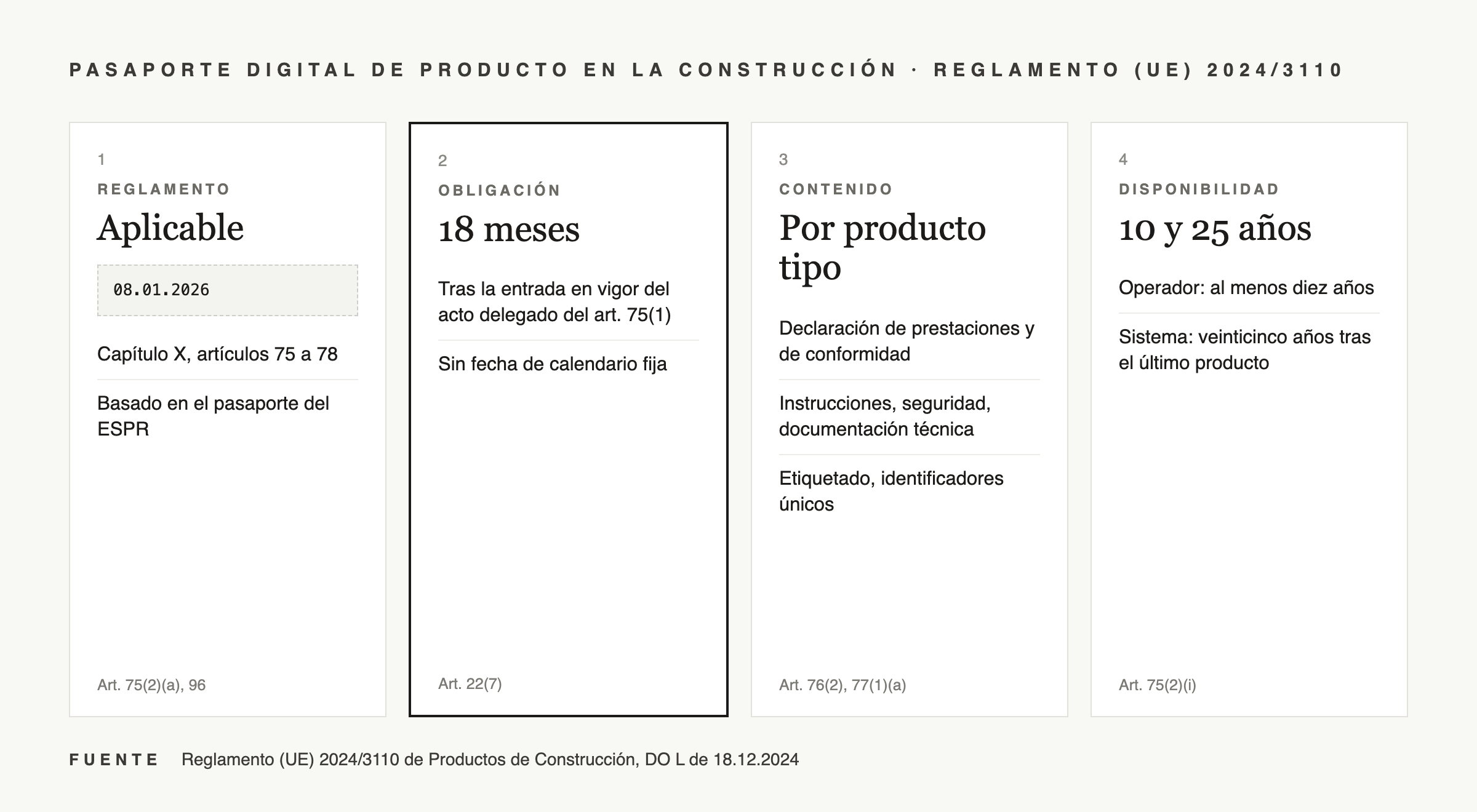
Construction products get a digital product passport of their own under the Construction Products Regulation (EU) 2024/3110, not under the Ecodesign Regulation's working plan. The regulation has applied since 8 January 2026 and sets up the passport in Chapter X (Articles 75 to 78), but the obligation starts only later: the manufacturer must make the passport available no later than 18 months after the delegated act under Article 75(1) enters into force (Article 22(7)). Unlike the battery passport, it is linked to the product type, not to each unit, and it must stay available for at least ten years.
Which law sets up the passport for construction products?
The Construction Products Regulation (CPR) of 27 November 2024 was published in the Official Journal on 18 December 2024. It applies from 8 January 2026, with some articles and annexes, among them those on scope and definitions, from 7 January 2025. It repeals the previous Regulation (EU) No 305/2011 with effect from 8 January 2026; some of its articles and annexes remain until 8 January 2040.
The passport itself is in Chapter X. Article 75(1) requires the Commission to adopt delegated acts that set up a digital product passport system for construction products. The system must be compatible and interoperable with the passport under the Ecodesign Regulation (EU) 2024/1781 and based on it, without compromising interoperability with building information modelling (Article 75(2)(a)). The general rules for ESPR passports are in What Is a Digital Product Passport?
When does it become required?
Article 22(7) sets the start: no later than 18 months after the delegated act under Article 75(1) enters into force, the manufacturer makes the passport available through the construction products passport system, connected to a data carrier. Until that act is in force, there is no passport obligation for construction products.
The regulation sets no calendar date. That is why the date is often given differently in different places. What counts is the entry into force of the delegated act, and 18 months after it at the latest.
What the passport contains
According to Article 76(2), the passport includes:
- the declaration of performance and conformity under Article 15, with the documentation provided with it;
- general product information, instructions for use and safety information (Article 22(6));
- the technical documentation (Article 22(3));
- the labelling (Article 22(9));
- the unique identifiers issued under Article 79(1);
- documentation required by other EU law applicable to the product;
- the data carriers of key parts for which a passport is available.
It must be connected to one or more data carriers, be accessible free of charge to all economic operators, customers, users and authorities through the data carrier, and offer different levels of access (Article 76(2)). Products exempt under Article 14 are also exempt from the passport (Article 76(4)).
One passport per product type, kept for years
Two points set the construction passport apart from the battery passport.
- Product type, not unit. The passport is connected to a permanent unique identification code of the product type (Article 77(1)(a)). A battery passport, by contrast, is required for each battery. See Digital Product Passport Example: What a Passport Shows.
- Long availability. The system must be accessible for twenty-five years after the last product of its type was placed on the market, and the economic operator must make the passport available for at least ten years (Article 75(2)(i)).
The delegated act must also set procedures to keep passports available after an insolvency, liquidation or cessation of activity of the economic operator, including a backup system by passport service providers (Article 75(2)(f)), and may set requirements for those service providers (Article 75(2)(g)). Personal data of the end user may not be stored in the passport without their explicit consent (Article 77(1)(e)).
Online sales: a digital copy within five working days
Article 77(3) adds a rule for distance sales. The manufacturer supplies those who sell the products online with a digital copy of the data carrier or the unique product identifier, so that customers who cannot access the product physically can see it. The economic operator supplies the copy or a link free of charge within five working days of a request.
What manufacturers of construction products can do now
- Follow the delegated act under Article 75(1). Its entry into force starts the 18-month clock.
- Put the declaration of performance and conformity in order. It is the core of the passport, together with the technical documentation.
- Assign identifiers per product type. The passport hangs on a permanent unique code for the product type, read through a data carrier such as a GS1 Digital Link QR code.
- Plan for ten years and more. Choose a solution that can keep passports available for the required period, also if your company or your supplier ceases to exist.
- Use the same standards as ESPR. Because the system builds on the ESPR passport, the CEN/CENELEC DPP standards are the reference.
Frequently asked questions
Is the digital product passport mandatory for construction products?
Not yet. Under Article 22(7) of Regulation (EU) 2024/3110 the manufacturer must make it available no later than 18 months after the delegated act under Article 75(1) enters into force.
Is the construction products passport the same as the ESPR passport?
No, it is set up by the Construction Products Regulation, but it must be compatible and interoperable with the ESPR passport and based on it (Article 75(2)(a)).
What does the construction products passport contain?
The declaration of performance and conformity, general product information, instructions for use and safety information, technical documentation, labelling, unique identifiers, documentation under other EU law and the data carriers of key parts (Article 76(2)).
Is there one passport per product or per product type?
Per product type. The passport is connected to a permanent unique identification code of the product type (Article 77(1)(a)).
How long must the passport stay available?
The system must be accessible for twenty-five years after the last product of the type was placed on the market, and the economic operator must make the passport available for at least ten years (Article 75(2)(i)).