Digital Product Passport in Denmark: Rules and Authorities
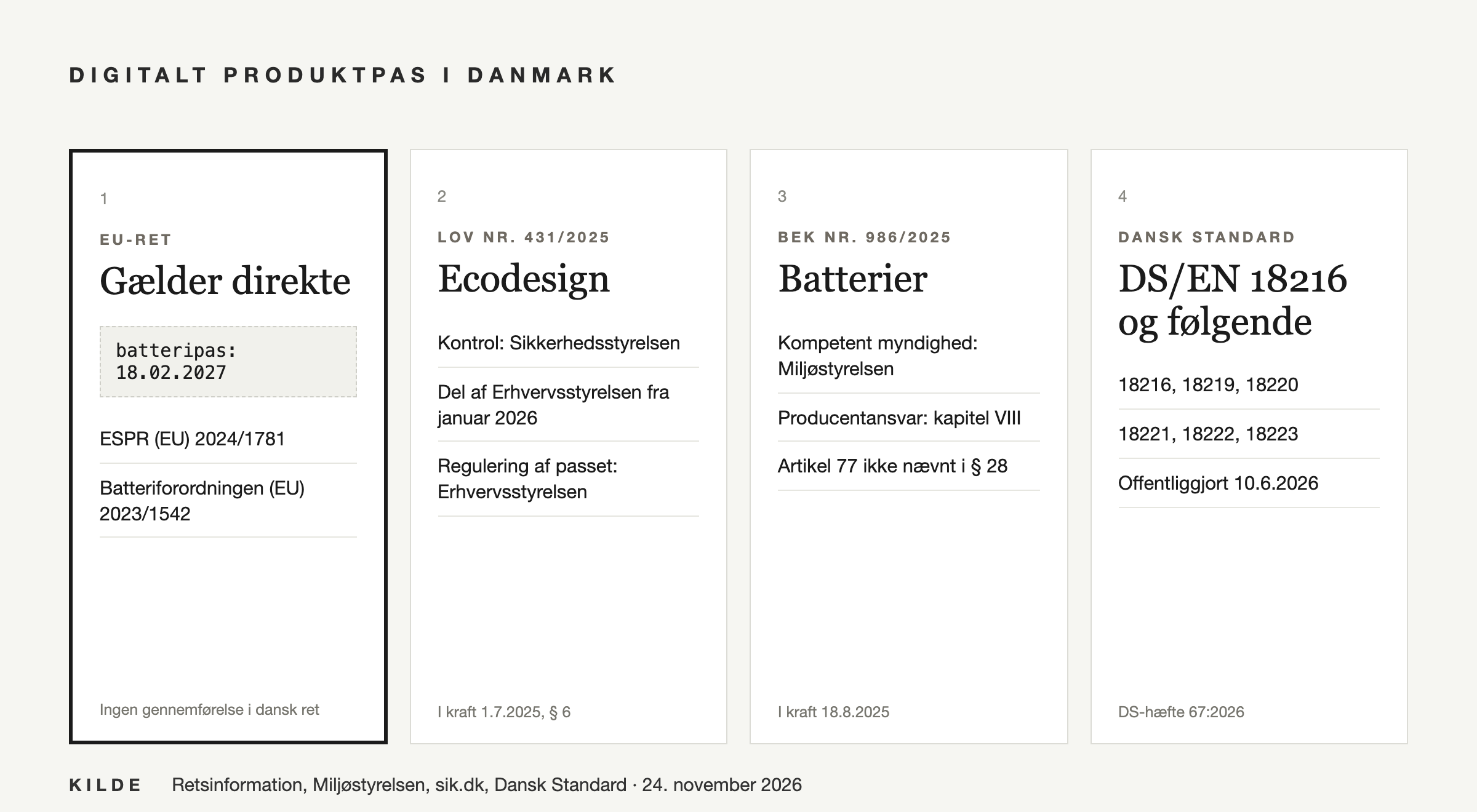
In Denmark the digital product passport follows directly from EU regulations. The Ecodesign Regulation (EU) 2024/1781 (ESPR) and the Battery Regulation (EU) 2023/1542 apply without transposition, and the first passport obligation is the battery passport from 18 February 2027. Denmark has added national rules on control: under the Ecodesign Products Act (Act No 431 of 6 May 2025) the Danish Safety Technology Authority (Sikkerhedsstyrelsen), part of the Danish Business Authority (Erhvervsstyrelsen) since January 2026, checks compliance with ESPR and its delegated acts. The Danish Environmental Protection Agency (Miljøstyrelsen) is the competent authority under the Battery Regulation. The passport standards are available in Denmark as DS/EN 18216 and following.
Which law requires a product passport in Denmark?
An EU regulation applies in every Member State on its own. The Danish government's bill for the Ecodesign Products Act states: EU regulations apply directly in the Member States and are not implemented in national law. What the Member States add are the rules needed to enforce them, including control and penalties.
ESPR itself requires a passport for no product. That happens in a delegated act per product group. According to Virksomhedsguiden, written by the Danish Energy Agency (Energistyrelsen), Miljøstyrelsen and Erhvervsstyrelsen, a transition period of at least 18 months follows the adoption of product-specific requirements before they apply, and textiles, footwear, consumer electronics and some materials such as steel and plastic are expected first. The general timeline is in ESPR Compliance Timeline.
The Battery Regulation sets its own date. From 18 February 2027 every LMT battery, every industrial battery above 2 kWh and every electric vehicle battery placed on the market must have a passport (Article 77(1)). Portable batteries and SLI batteries are outside the passport requirement. Miljøstyrelsen's table of application dates for the Battery Regulation lists Article 77(1) with the same date. More in EU Battery Passport and in the DPP Academy episode on batteries.
The Ecodesign Products Act: who checks what
Act No 431 of 6 May 2025 on supplementary provisions to the Ecodesign Regulation (ecodesignproduktloven) entered into force on 1 July 2025. Section 6 divides control:
- Sikkerhedsstyrelsen checks compliance with the Act, ESPR and its delegated and implementing acts, and the Market Surveillance Regulation (EU) 2019/1020.
- The Minister for Climate, Energy and Utilities and the Minister for the Environment supervise notified bodies.
- The Minister for the Environment checks the rules in implementing acts adopted under Article 65 of ESPR.
Sikkerhedsstyrelsen has been part of Erhvervsstyrelsen since January 2026. It already controls the energy-related ecodesign rules: it checks suppliers' documentation, selects suppliers on a risk basis and can issue orders, bans or report a case to the police.
Miljøstyrelsen describes the division of work around ESPR this way: the Ministry of Climate, Energy and Utilities is responsible overall, Miljøstyrelsen and Energistyrelsen are responsible for ecodesign requirements in their own fields, and Erhvervsstyrelsen is responsible for the regulation of the digital product passport and for market surveillance of product requirements.
Two areas are left to other rules. The bill states that control and penalties for ESPR Chapter VI, the destruction of unsold consumer products, will be handled under the Ministry of Environment and Gender Equality, and that control of economic operators' upload of battery passports to the registry of digital product passports (ESPR Articles 13 and 78) will be handled by the authority responsible for market surveillance of the battery passport under the Battery Regulation.
Batteries: Miljøstyrelsen and Order 986/2025
Denmark supplements the Battery Regulation with Order No 986 of 20 June 2025, in force since 18 August 2025. Section 3 makes Miljøstyrelsen the competent authority under Article 54(1) of the Battery Regulation. Under section 28 Miljøstyrelsen supervises compliance with Articles 5(1)(a), 6 and Annex I, 13(5), 18(1), 38, 41 to 43 and 81(2), and with Chapter VIII, extended producer responsibility.
Article 77, the battery passport, is not among the articles listed in section 28. We found no Danish rule on 24 November 2026 that names the authority for market surveillance of the battery passport. The obligation applies regardless: the economic operator that places the battery on the market is responsible for the passport.
Unsold products: the destruction ban
ESPR's ban on destroying unsold apparel, clothing accessories and footwear has applied to large enterprises since 19 July 2026 and applies to medium-sized enterprises from 19 July 2030 (Article 25 and Annex VII). Micro and small enterprises are excluded. Companies that discard unsold consumer products must also disclose once a year how many they discarded and why (Article 24). Miljøstyrelsen describes both on its ecodesign page. The ban needs no passport, but the data overlap: product identity, quantities and what happened to each product.
Timetable
| Date | What happens | Source |
|---|---|---|
| 18 July 2024 | ESPR enters into force | Regulation (EU) 2024/1781 |
| 1 July 2025 | Ecodesign Products Act in force; Sikkerhedsstyrelsen controls ESPR | Act No 431/2025 |
| 18 August 2025 | Miljøstyrelsen competent authority under the Battery Regulation | Order No 986/2025 |
| January 2026 | Sikkerhedsstyrelsen becomes part of Erhvervsstyrelsen | sik.dk |
| 10 June 2026 | Six DPP standards announced as DS/EN | Dansk Standard |
| 19 July 2026 | Destruction ban on unsold apparel and footwear, large enterprises | ESPR Article 25 |
| 20 July 2026 | EU digital product passport registry opens | Implementing Regulation (EU) 2026/1778 |
| 18 February 2027 | Battery passport required for LMT, industrial above 2 kWh and EV batteries | Battery Regulation Article 77(1) |
| Fourth quarter of 2027 | Planned adoption of the textile delegated act | European Commission |
| 19 July 2030 | Destruction ban and disclosure also for medium-sized enterprises | ESPR Articles 24 and 25 |
The registry stores the unique identifier and links to the passport; the passport itself stays with the economic operator or a service provider. More in EU DPP Registry, and the registration steps for batteries in Battery Passport Registration.
DS/EN 18216 and following: the standards in Denmark
Dansk Standard announced on 10 June 2026 that the first six European passport standards are ready:
| Standard | Subject |
|---|---|
| DS/EN 18216 | Data exchange protocols |
| DS/EN 18219 | Unique identifiers |
| DS/EN 18220 | Data carriers |
| DS/EN 18221 | Data storage, archiving and data persistence |
| DS/EN 18222 | APIs for passport lifecycle management and searchability |
| DS/EN 18223 | System interoperability |
Danish companies, authorities and organisations take part through Dansk Standard's committee for the digital product passport. At the time Dansk Standard expected the two further standards, on access rights and authentication, later in 2026. Dansk Standard has also published a guide for companies preparing for the passport, DS-hæfte 67:2026. Which of the eight standards are cited in the Official Journal is in CEN/CENELEC DPP Standards, and how they fit together in the DPP Academy episode on the standards.
Textiles and GS1 Denmark
The Commission plans to adopt the textile delegated act in the fourth quarter of 2027, and that act will fix which data a textile passport holds. What is known so far is in DPP Requirements for Textiles.
GS1 Denmark describes the passport as a set of sustainability data for a physical product, where each product is uniquely identified and digitally linked to one or more data sources, and states that it can be built with GS1 standards, among others: the GTIN identifies the product, and a 2D barcode with GS1 Digital Link carries the link. More in GS1 Digital Link and the DPP.
What companies in Denmark can do now
- Batteries first. If you place LMT batteries, industrial batteries above 2 kWh or EV batteries on the market, the passport is required from 18 February 2027.
- Find out your role. The economic operator that first places the battery on the EU market is responsible for the passport. For a Danish importer of batteries from outside the EU, that can be you.
- Prepare for Sikkerhedsstyrelsen. When a delegated act applies to your product group, Sikkerhedsstyrelsen checks the documentation, and the passport is part of it.
- Name the standards when choosing a system. Ask for DS/EN 18216 and following by number and edition.
- Record unsold products. Large enterprises have been under the destruction ban for apparel and footwear since 19 July 2026.
- Check what you already have. The validator checks a passport against the EN standards and the EU registry data model. A complete example is in Digital Product Passport Example.
Frequently asked questions
Is the digital product passport mandatory in Denmark?
Yes, where EU law requires it, because EU regulations apply directly. The first obligation is the battery passport from 18 February 2027. For other products it starts when the delegated act for their product group applies.
Who checks the digital product passport in Denmark?
For products under ESPR, Sikkerhedsstyrelsen under section 6 of Act No 431/2025; it has been part of Erhvervsstyrelsen since January 2026. Erhvervsstyrelsen is responsible for the regulation of the passport.
Who is responsible for the battery passport in Denmark?
Miljøstyrelsen is the competent authority under the Battery Regulation (Order No 986/2025). The order does not list Article 77, and we found no Danish rule naming the authority for market surveillance of the battery passport.
What is a digital product passport?
A set of data about a product, such as composition, origin, repair and recycling, reached by scanning a QR code or another data carrier on the product. More in What Is a Digital Product Passport?.
Which Danish standards apply to the digital product passport?
DS/EN 18216, 18219, 18220, 18221, 18222 and 18223. Dansk Standard announced them on 10 June 2026.
Sources
- Regulation (EU) 2024/1781 (ESPR): Articles 13, 24, 25, 65 and 78, Annex VII. EUR-Lex
- Regulation (EU) 2023/1542 (Battery Regulation): Articles 54 and 77(1). EUR-Lex
- Commission Implementing Regulation (EU) 2026/1778 on the digital product passport registry. EUR-Lex
- Act No 431 of 6 May 2025 on supplementary provisions to the Ecodesign Regulation (ecodesignproduktloven): sections 6 and 22. Retsinformation
- Bill L 122 (2024-25) for the Ecodesign Products Act, general remarks section 1 and 3.1.2. Retsinformation
- Order No 986 of 20 June 2025 on supplementary provisions to the Battery Regulation: sections 3, 28 and 31. Retsinformation
- Miljøstyrelsen, When do the Battery Regulation's requirements apply?, 14 March 2024. Miljøstyrelsen
- Miljøstyrelsen, Ecodesign: the Ecodesign Regulation. Miljøstyrelsen
- Energistyrelsen, Miljøstyrelsen and Erhvervsstyrelsen, Ecodesign (ESPR): coming requirements on product sustainability. Virksomhedsguiden
- Sikkerhedsstyrelsen (Erhvervsstyrelsen), How ecodesign control works. sik.dk
- Dansk Standard, The first standards for the digital product passport are ready, 10 June 2026. Dansk Standard
- European Commission, Textile Apparel and the Digital Product Passport. Commission
- GS1 Denmark, The digital product passport. GS1 Denmark