SIS and DPP: The Eight Swedish Product Passport Standards
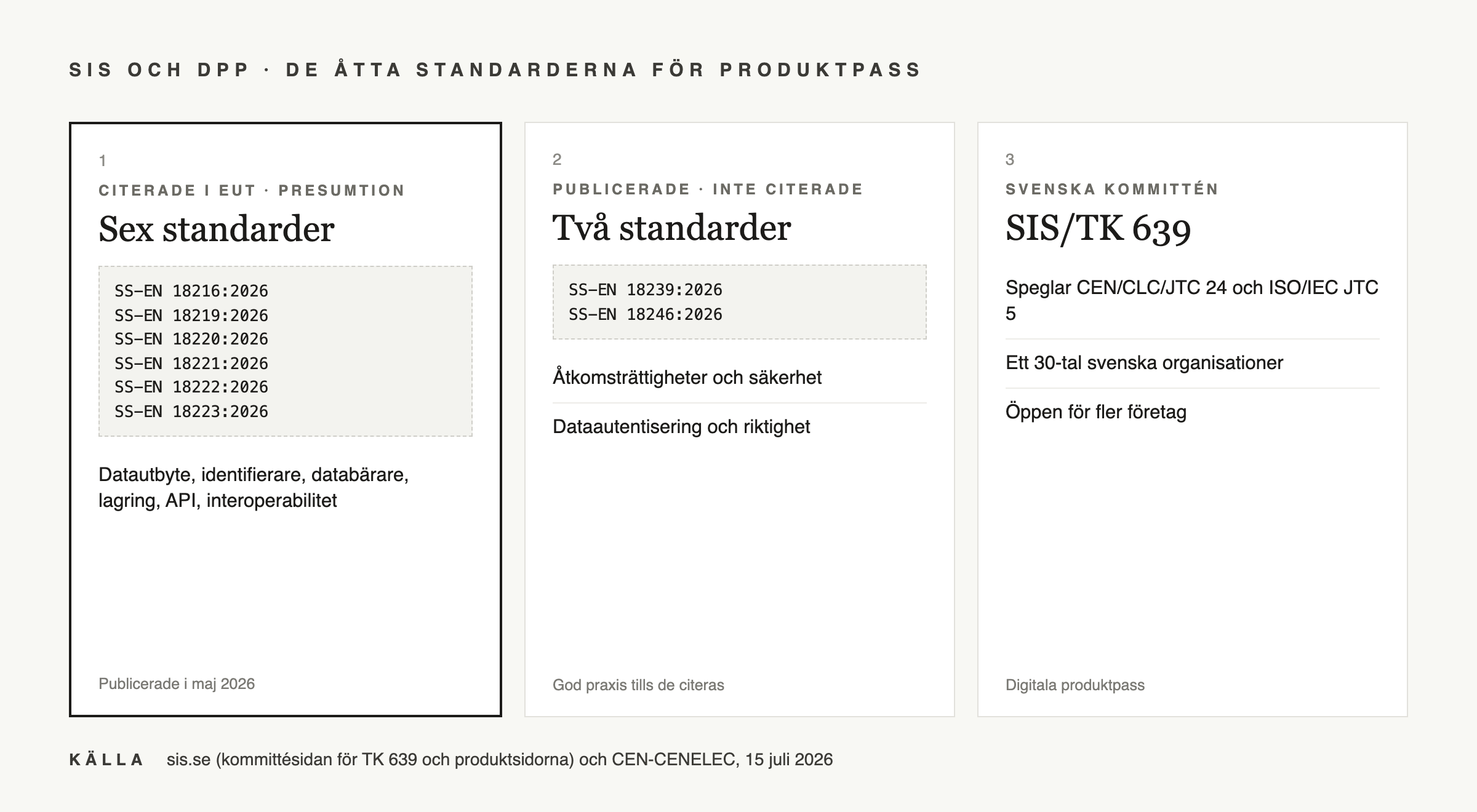
SIS, the Swedish Institute for Standards, is the body that publishes the standards for Digital Product Passports (DPP) in Sweden. All eight European DPP standards from CEN/CLC/JTC 24 are now Swedish standards, SS-EN, and are bought from SIS. The Swedish work takes place in the technical committee SIS/TK 639 Digitala produktpass, which is open to companies that want a say in the next version.
What does SIS have to do with Digital Product Passports?
European standards are written in CEN and CENELEC, but they are published and sold by each country's national standardisation body. CEN-CENELEC itself says organisations obtain the DPP standards through their National Standardization Body. In Sweden that is SIS.
When a European standard is adopted, it becomes a Swedish standard with the prefix SS. EN 18216:2026 thus becomes SS-EN 18216:2026. The content is the same. SIS's product pages for SS-EN 18216:2026 and SS-EN 18239:2026 give English as the language, so expect English text.
The standards support ESPR, the Ecodesign for Sustainable Products Regulation (EU) 2024/1781. They were developed by the joint committee CEN/CLC/JTC 24 under the Commission's standardisation request M/604.
Which DPP standards are available from SIS?
The committee page for SIS/TK 639 lists eight published standards:
| Swedish standard | Title | Cited in the OJ |
|---|---|---|
| SS-EN 18216:2026 | Data exchange protocols | Yes |
| SS-EN 18219:2026 | Unique identifiers | Yes |
| SS-EN 18220:2026 | Data carriers | Yes |
| SS-EN 18221:2026 | Data storage, archiving and data persistence | Yes |
| SS-EN 18222:2026 | Application Programming Interfaces (APIs) for product passport lifecycle management and searchability | Yes |
| SS-EN 18223:2026 | System interoperability | Yes |
| SS-EN 18239:2026 | Access rights management, information system security and business confidentiality | No |
| SS-EN 18246:2026 | Data authentication, reliability and integrity | No |
The first six were approved on 27 May 2026. SIS gives that date for SS-EN 18216:2026. SS-EN 18239:2026 was approved on 16 September 2026.
Do not write the series as "18216–18223". It sounds like eight consecutive standards, but 18217 and 18218 do not exist, and the two newest, 18239 and 18246, fall outside the range. Cite each standard by number.
What do the eight standards cover?
A short overview. Clause by clause, it is in our article on the six CEN standards.
- SS-EN 18216, data exchange protocols. How the passport is requested and in which format. JSON is the baseline format, and the same address must be able to return a web page to a person and machine-readable data to a system.
- SS-EN 18219, unique identifiers. The requirements on the passport's address: globally unique, persistent even if the operator ceases to exist, and at the right level (model, batch or individual item). GS1 Digital Link is one of the permitted routes. More in GS1 Digital Link and DPP.
- SS-EN 18220, data carriers. QR code, Data Matrix, RFID and NFC: how the identifier gets from the product to the reader.
- SS-EN 18221, data storage, archiving and data persistence. Version history from the first change, and the back-up copy at a service provider where the product's rules require it.
- SS-EN 18222, APIs. The interfaces for managing the passport over its lifecycle and for searching for passports.
- SS-EN 18223, system interoperability. How different systems understand the same passport, including the header information every passport must carry.
- SS-EN 18239, access rights and security. According to SIS's summary: requirements for access rights management, IT security, data protection and the transfer of responsibility between economic operators. Public passport data requires no access restrictions. Who may see what is set in the delegated acts for each product group.
- SS-EN 18246, data authentication, reliability and integrity. How a recipient can trust that the passport comes from the right operator and has not been altered.
What does it mean that six are cited and two are not?
A harmonised standard cited in the Official Journal of the EU gives presumption of conformity. If you follow it, you are presumed to meet the corresponding requirement in ESPR. CEN-CENELEC wrote on 15 July 2026 that six of the eight are cited. According to our review, this was done by Commission Implementing Decision (EU) 2026/1736.
SS-EN 18239 and SS-EN 18246 are adopted and can be bought, but they are not cited. You can follow them and show that you do, but you get no presumption. That applies to every supplier, so anyone claiming harmonised conformity with "all eight" is wrong. The difference is explained in All eight DPP standards are published. Only six are cited.
Do we need to buy the standards?
It depends on who builds the passport.
- You build it yourselves. Then your developers need the text, first of all SS-EN 18216, 18219, 18220, 18221, 18222 and 18223. Those are the six that give presumption.
- You use a platform. Then it is the supplier who has to follow the standards. Ask which clauses the platform follows, and check for yourselves what can be seen from outside.
- You are procuring. State the standards by number and edition in the requirements, for example SS-EN 18219:2026, not "the DPP standards".
SIS also offers a free guide to the DPP standards on its page about Digital Product Passports. It gives an overview without having to buy the texts themselves.
What is visible from outside can be checked without buying anything. Our validator runs ten checks against seven of the eight standards on any passport address, without an account.
What does SIS/TK 639 Digitala produktpass do?
TK 639 is the Swedish committee for Digital Product Passports. According to SIS, it works on standards for how product data is shared, stored, identified and protected between actors under ESPR. The committee page lists the international groups it is linked to:
- CEN/CLC/JTC 24, Digital Product Passport – Framework and System
- JTC 24/WG 1, Strategic Advisory Group
- JTC 24/WG 2, Unique identifiers and data carriers
- JTC 24/WG 3, Security
- JTC 24/WG 4, Interoperability framework
- ISO/IEC JTC 5, Digital Product Passport
According to SIS, some 30 Swedish organisations take part, and Sweden leads the working group for unique identifiers and data carriers.
The committee has three projects in progress: one on dictionary referencing (Dictionary referencing: Concepts and principles) and two global ISO/IEC projects, ISO/IEC AWI 25534-1 on concepts and terminology and ISO/IEC AWI 25534-2 on overview and fundamental principles. SIS wrote in May 2026 that ISO and IEC begin developing global DPP standards during the year, and that the revision of the European standards will start soon.
The committee's plan for 2027 describes it as "an active platform for influencing standardisation of Digital Product Passports at European and global level". The focus shifts towards implementation and global alignment, and the committee follows the Commission's upcoming delegated acts under ESPR.
How can a Swedish company take part?
There are two routes.
1. Join TK 639. SIS says standardisation is an open process and that all kinds of stakeholders are welcome. You register your interest with SIS. Participants get access to the SIS participant portal, and the basic training in standardisation is free for them. As a participant, you help shape the Swedish position in the European and global work.
2. Comment on drafts. On kommentera.sis.se, anyone who registers can read and comment on draft Swedish standards from CEN, ISO and SIS, free of charge. The DPP standards went out for comment there before they were adopted, and the next revision and the global ISO/IEC projects will too.
Which route fits depends on how much you want to influence. A brand that only wants to understand the requirements can manage with the guide and the published standards. Those who build systems, or sell in a sector with its own needs, have more to gain from joining the committee before the next version is written.
What should you do now?
- Read the SIS guide for an overview.
- Establish who builds your passports, you or a supplier.
- Require the six cited standards by number and edition in contracts and procurements.
- Treat SS-EN 18239 and SS-EN 18246 as good practice, not as presumption, until they are cited.
- Check one of your passports against what can be tested from outside.
- Consider joining TK 639 if you want to influence the revision.
The standards are also explained in the DPP Academy episode on the CEN standards.
Frequently asked questions
Where do you buy the DPP standards in Sweden?
From SIS, the Swedish Institute for Standards. They are available as SS-EN 18216:2026, SS-EN 18219:2026, SS-EN 18220:2026, SS-EN 18221:2026, SS-EN 18222:2026, SS-EN 18223:2026, SS-EN 18239:2026 and SS-EN 18246:2026.
Are the SS-EN versions in Swedish?
SIS's product pages for SS-EN 18216:2026 and SS-EN 18239:2026 give English as the language. The titles are translated on SIS's page about Digital Product Passports, but the text itself is the English one.
Which SIS committee works on Digital Product Passports?
SIS/TK 639 Digitala produktpass. It is linked to CEN/CLC/JTC 24 and its four working groups, and to ISO/IEC JTC 5.
Do all eight standards give presumption of conformity?
No. Only the six cited in the Official Journal of the EU: EN 18216, 18219, 18220, 18221, 18222 and 18223. EN 18239 and EN 18246 are published but not cited.
Does it cost anything to comment on a draft standard?
No. On kommentera.sis.se, anyone who registers can read and comment on drafts free of charge.
Sources
- SIS, SIS/TK 639 Digitala produktpass: the committee's scope, international links, the eight published standards, projects in progress and the plan for 2027. sis.se
- SIS, Digitala produktpass: the Swedish titles of the eight standards and the guide to the DPP standards. sis.se
- SIS, SS-EN 18216:2026: status valid, approved 27 May 2026, language English. sis.se
- SIS, SS-EN 18239:2026: status valid, approved 16 September 2026, scope. sis.se
- SIS, news 7 May 2026: Swedish participation and the ISO/IEC work. sis.se
- SIS, Kommentera: free review of draft standards. kommentera.sis.se
- CEN-CENELEC, 15 July 2026: JTC 24, M/604, six of eight cited in the OJ, obtained through the national standardisation body. cencenelec.eu