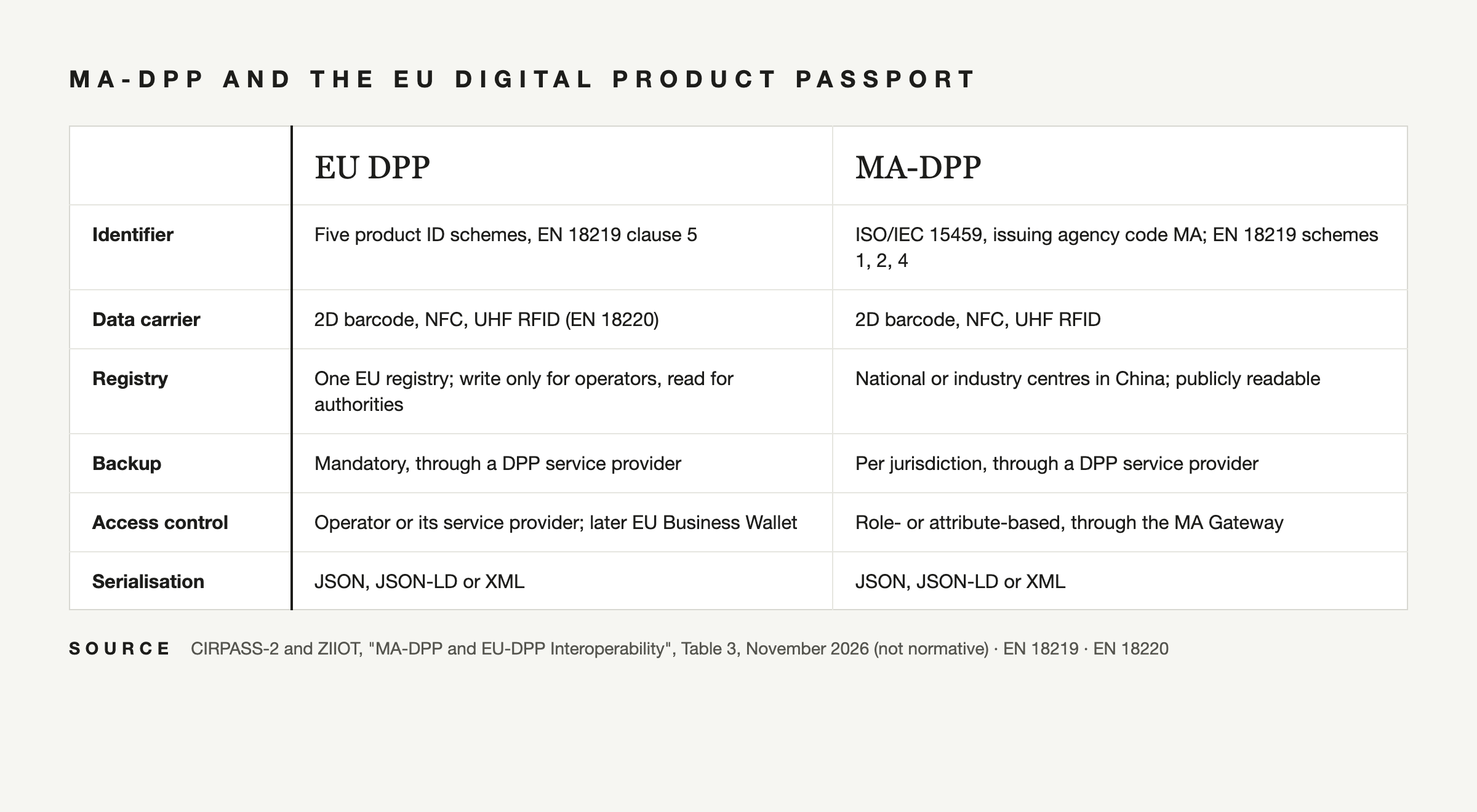
MA-DPP and the EU Digital Product Passport
An MA-DPP identifier can serve as the unique product identifier of an EU digital product passport, according to a white paper published on 16 November 2026 by the EU-funded CIRPASS-2 project and ZIIOT, the Chinese institute behind the MA-DPP system. MA identifiers are ISO/IEC 15459 identifiers with the issuing agency code "MA", structured with ISO/IEC 15418 data identifiers and written as web addresses under ISO/IEC 18975. That is ID scheme 1 of EN 18219, the European standard for passport identifiers. One QR code with an MA-based URL can resolve to both the MA-DPP and the EU passport. The passport still has to be registered in the EU DPP Registry, by the economic operator or on its behalf, and the EU back-up copy is still required. The paper is not normative and does not state the view of the European Commission.
What the paper is
"MA-DPP and EU-DPP Interoperability" was written by two CIRPASS-2 authors (CEA and Eco Wise) and seven from ZIIOT, the Zhongguancun Industry and Information Research Institute of Two-Dimensional Code Technology. It was published on Zenodo on 16 November 2026 as version 1.0. CIRPASS-2 is EU-funded (grant agreement 101158775).
The paper is provided "for exploration and for information purposes only" and is not "complete, exhaustive, or normative". Its reading of the EU system is the authors' own and does not necessarily reflect the views of the EU, the Commission or CEN/CENELEC JTC 24; it rests on the CIRPASS-2 reference architecture. MA-DPP is ZIIOT's passport system, built on its MA identification system and piloted in steel, batteries and textiles in China.
How an MA code fits EN 18219
ID scheme 1 of EN 18219 (clause 5.2) is an ISO/IEC 15459 identifier, structured with ISO/IEC 15418 data identifiers and written as a URL per ISO/IEC 18975, as a structured path (5.2.2.1) or a query string (5.2.2.2). Both require an issuing agency code registered under ISO/IEC 15459-2.
According to the paper, the "MA" issuing agency code is registered by AIM Global under ISO/IEC 15459-2. An MA identifier has three segments: the company (MA, a country or domain code, a regional or industry code and a company code), the object category, and the individual object, marked with data identifiers such as 1T for batch and S for serial number. The paper's two URL examples:
| Format | Example from the paper |
|---|---|
| Structured path | https://example.com/25P/MA.156.M2.Y01463.00001066/1T/240312/S/0205?14D=20270311 |
| Query string | https://example.com/?.25P=MA.10013.3122.1000.31.2201.01JDZ66C&.1T=abc&.S=12345&.16D=20260430 |
In the first, 25P carries the product model, 1T the batch, S the serial number and 14D an expiry date. The paper says the domain is "controlled by the responsible economic operator or DPPSP" and that nationally operated servers are not mandatory. The identifier works at model, batch or item level, which each EU delegated act sets (Academy: model, batch or item). The paper's comparison table also lists EN 18219 schemes 2 (Identification Link) and 4 (RAIN RFID and compact 2D codes) as supported.
ESPR names the base standard: the last paragraph of Annex III to Regulation (EU) 2024/1781 requires the data carrier and the product, operator and facility identifiers to comply with ISO/IEC 15459-1 to 15459-6, "where relevant for the products concerned". GS1 is one issuing agency under that standard; MA is another.
Operator and facility identifiers
EN 18219 clause 6 gives two routes an exporter from China is likely to meet: ID scheme 6 (6.2), based on ISO/IEC 6523, with the Legal Entity Identifier and PEPPOL IDs among the examples, and ID scheme 7 (6.3), ISO/IEC 15418 data identifiers with an issuing agency code registered under ISO/IEC 15459-2. MA codes use data identifier 18V for organisations and 26L for locations. The paper does not map these to a scheme, so whether an MA operator code meets clause 6.3.2 is still to be checked.
MA-DPP and EU DPP compared
Six rows from Table 3 of the paper, with standard clauses added where we checked them:
| EU DPP | MA-DPP | |
|---|---|---|
| Identifier | Five product ID schemes in EN 18219 clause 5 | ISO/IEC 15459 with issuing agency code MA; EN 18219 schemes 1, 2 and 4 |
| Data carrier | 2D barcode, NFC and UHF RFID (EN 18220 clause 6) | 2D barcode, NFC and UHF RFID |
| Registry | One EU registry run by the Commission, with minimal metadata; write only for operators, read access for authorities | National or industry registration centres in China, run by public administrations or industry associations; publicly readable |
| Backup | Mandatory through a DPP service provider; the backup link is registered | Supports backup requirements of each jurisdiction through a DPP service provider |
| Access control | Short term: the responsible operator or its service provider. Long term: organisational identities such as the EU Business Wallet | Role-based or attribute-based access control through the MA Gateway |
| Serialisation | JSON, JSON-LD or XML | Serialised data models in JSON, JSON-LD or XML |
According to the paper, both registries store the product, operator and facility identifiers, the passport web link and a registration identifier; the EU registry also stores the backup web link. ESPR Article 13(1) sets the minimum: the unique identifiers, the commodity code for products released for free circulation, and the battery identifiers of Article 77(3) of the Battery Regulation. The paper cites Implementing Regulation (EU) 2026/1778 for the registry's components (see the registry launch).
The EU registry does not resolve an identifier to a web link: the EU system assumes the data carrier holds the link or that a resolution service exists for the product. MA-DPP offers resolution where needed.
The four principles for interoperable passports
Section 1.3 of the paper sets out four principles the authors agreed on:
- Sovereignty. A jurisdiction that makes a passport mandatory for its market decides the requirements: its own standards, information requirements and access rights.
- Public access everywhere. Consumers should be able to read the public information of any passport wherever they are. Where a jurisdiction's passport is mandatory for the product, that passport should be shown by default based on the consumer's location.
- Usable data. Data retrieved from any passport system should be usable, which requires semantic interoperability and vocabularies built on the FAIR principles.
- Low cost for companies. Companies selling in several markets should need as few data carriers as possible, and a single web link should be able to resolve to different passports.
What it means for a Chinese factory and an EU brand
Section 5 of the paper describes one QR code with an MA-based URL that returns MA-DPP information for manufacturing, quality inspection and carbon footprint tracking in China, and the EU passport for compliance, repair and recycling in Europe. For a product made in China and sold in the EU:
- Agree who the responsible economic operator is. Under ESPR Article 13(4), the economic operator placing the product on the EU market uploads the data to the registry: usually the brand or the importer, not the factory (the six economic operators in ESPR).
- Put the URL on a domain the operator controls. The paper allows the operator's or the service provider's domain; the operator's own keeps the label valid if the service changes.
- Use one data carrier. The factory prints one QR code with the MA URL. The EU request must return the EU passport with the content the delegated act requires.
- Register in the EU DPP Registry. The paper describes three ways: by the operator, by an MA-DPP service provider, or by the MA-DPP Registration and Administration Center under a delegation agreement with the operator. The registry then queries the passport to verify it (battery passport registration, Academy: the EU registry).
- Keep the EU back-up copy. ESPR Article 10(4) requires a back-up copy through a DPP service provider; Annex III point (l) lists that provider's reference among the elements a delegated act can put in the passport. In the paper's cross-border flow the backup sits with an MA-DPP service provider. The paper gives ten years as the default retention, to be refined per product group.
- Check the address. The DPP validator checks a passport URL against the published JTC 24 standards, including which EN 18219 ID scheme the identifier follows. Whether an issuing agency code is registered under ISO/IEC 15459-2 it reports as not checkable automatically.
What is still open
- Registry reading. The EU registry is write-only for operators; the Commission, national authorities and customs have access (ESPR Article 13(6)). An MA-DPP registration centre is publicly readable. In the EU, public search goes through a separate web portal, within each stakeholder's access rights (ESPR Article 14).
- Access rights. Who sees which part of an EU passport is set per product group in the delegated acts. MA-DPP's role- and attribute-based access has to be mapped to those rights, product group by product group (Academy: who sees what).
- Location-based redirection. The paper calls it "one possibility, among others" for serving different requirements from one link. It is not a rule, and the paper does not define how a resolver should decide.
- Backup provider. The paper does not say whether an MA-DPP service provider would appear on the EU registry's reference list of verified DPP service providers.
- Content. The EU data models per product group come from the Commission; the paper says MA-DPP supports adaptation to them, but does not show a mapped example.
- Status. ESPR names ISO/IEC 15459, not MA-DPP. The paper concludes that global cooperation is needed to build gateway technologies and pilot environments; it reports no cross-border pilot.
For batteries the question comes first: the battery passport is required from 18 February 2027 for LMT batteries, industrial batteries above 2 kWh and EV batteries (Article 77(1) of the Battery Regulation). The paper cites China's 15th Five-Year Plan for the new battery industry (September 2026), which calls for internationally recognised battery passport solutions. DPP standards after CIRPASS-2 lists the Chinese standards work.
Frequently asked questions
Does an MA code work as an EU digital product passport identifier?
According to the CIRPASS-2 and ZIIOT paper, yes: MA identifiers are ISO/IEC 15459 identifiers with ISO/IEC 15418 data identifiers and ISO/IEC 18975 URLs, ID scheme 1 of EN 18219. The paper is not normative.
Can one QR code serve both MA-DPP and the EU passport?
The paper describes one MA-based URL in one QR code resolving to both. Location-based redirection is one way it names, not a requirement.
Who registers an MA-DPP in the EU DPP Registry?
ESPR Article 13(4) puts the upload on the economic operator placing the product on the EU market. The paper adds that an MA-DPP service provider or registration centre can do it under delegation.
Is a back-up copy still needed when MA-DPP is used?
Yes. ESPR Article 10(4) requires it, and the paper's cross-border flow keeps that step.
Is MA-DPP recognised by the European Commission?
ESPR does not name it; it names ISO/IEC 15459, under which MA is an issuing agency code. The paper's disclaimer says its views are the authors', not necessarily the Commission's.
Sources
- CIRPASS-2 and ZIIOT: Bernier, C., Koppelaar, R., Zhang, C., Niu, X., Sui, J., Hu, L., Liu, L., Chen, S., & Liu, D. (2026). "MA-DPP and EU-DPP Interoperability: A comparative analysis of the EU-DPP and MA-DPP systems". CIRPASS-2 consortium, sections 1.3, 3.1, 3.2.4, 4 (Table 3) and 5. Zenodo
- CIRPASS-2: project page. CIRPASS-2, About
- Regulation (EU) 2024/1781 (Ecodesign for Sustainable Products Regulation): Articles 10(4), 13(1), 13(4), 13(6), 14 and Annex III. EUR-Lex
- Regulation (EU) 2023/1542 (Battery Regulation): Article 77(1) and 77(3). EUR-Lex
- EN 18219:2026, unique identifiers: clause 5.2 (ID scheme 1), 5.3 (scheme 2), 5.5 (scheme 4), 6.2 (scheme 6) and 6.3 (scheme 7).
- EN 18220:2026, data carriers: clause 6.
- CEN-CENELEC: "Digital Product Passport, the cornerstone…", 15 July 2026. CEN-CENELEC