Digital Product Passport Standards After CIRPASS-2 Ends
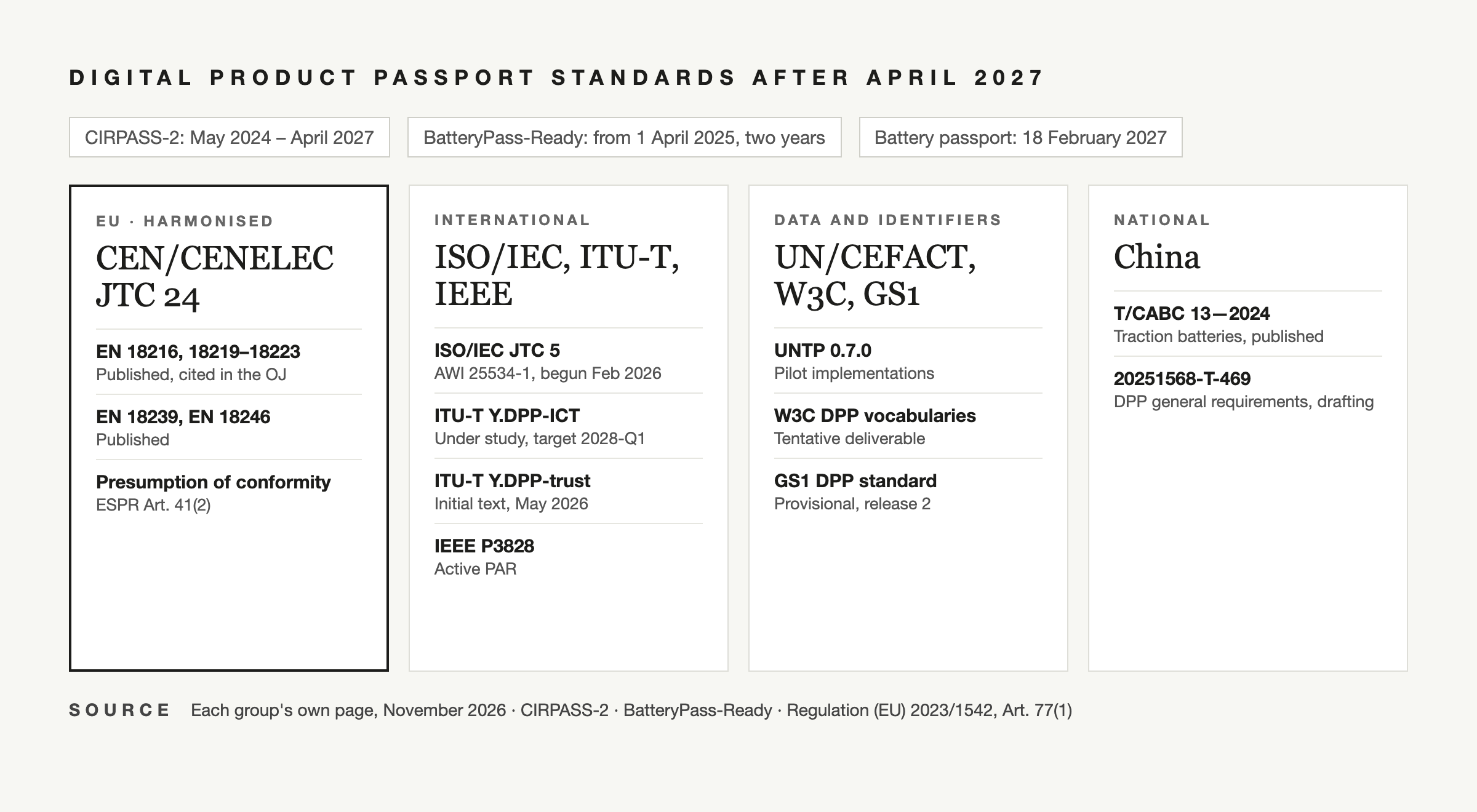
Digital product passport standards are moving from EU-funded projects to standards bodies. CIRPASS-2, the Digital Europe project that pilots passports in four value chains, runs from May 2024 until April 2027, and BatteryPass-Ready, the German battery passport project, was launched on 1 April 2025 to run for two years. After that the work sits in committees: CEN/CENELEC JTC 24, whose eight European standards are published, the new ISO/IEC JTC 5, and groups at ITU-T, UN/CEFACT, IEEE, W3C, GS1 and in China, most of them at draft or work-item stage. A passport chosen today should rest on the EU regulations and the JTC 24 standards cited in the Official Journal, with identifiers and data that can move to whichever international stack follows.
When the EU-funded projects end
| Project | Funded by | Runs | Source |
|---|---|---|---|
| CIRPASS-2 | Digital Europe Programme (Innovation Action) | May 2024 to April 2027 | CIRPASS-2, About |
| BatteryPass-Ready | German Federal Ministry for Economic Affairs and Energy (BMWE) | Launched 1 April 2025, two years | Press release, 22 May 2025 |
CIRPASS-2 said at a presentation in November 2026 that there will not be a CIRPASS-3. The same presentation described the change ahead as one from thousands of non-standardised passports today to several standardised DPP stacks.
The projects leave tools and documents behind. CIRPASS-2 has published an open-source test environment (16 June 2026) with a mock EU registry, a passport renderer and a validation service, and a report on DPP standardisation initiatives around the world (version 1.1, 25 June 2026). BatteryPass-Ready aims for full public release of its battery passport test environment in Q1/2027 and states that it "is not a certification system, but a testing and learning platform". Our earlier article on CIRPASS and CEN/CENELEC covers the first CIRPASS project.
Who writes digital product passport standards after 2027
Each status below is the one the group's own page gives. Where a group has no public page describing its DPP work, the source is named.
| Group | Work on DPP | Status as published |
|---|---|---|
| CEN/CENELEC JTC 24 | EN 18216, 18219 to 18223, 18239 and 18246: the DPP system under ESPR | Eight published; six cited in the Official Journal |
| ISO/IEC JTC 5 | International DPP standards; mirror committee of JTC 24 | New committee; ISO/IEC AWI 25534-1 begun 12 February 2026 |
| ISO/TC 307 WG 8 | ISO 20435, a decentralised identifier framework for physical assets | No status given in the CIRPASS-2 report |
| ITU-T SG20, Q5/20 | Y.DPP-ICT, DPP for ICT goods; Y.DPP-trust, trust framework | Y.DPP-ICT under study, target 2028-Q1; Y.DPP-trust initial text, May 2026 |
| UN/CEFACT | UN Transparency Protocol (UNTP), including a DPP credential | Version 0.7.0, for pilot implementations; 1.0 expected |
| IEEE CTS/DFESC | IEEE P3828, DPP reference architecture and technical requirements | Active PAR, approved 26 September 2024 |
| W3C Verifiable Credentials WG | Vocabularies for Digital Product Passports | Tentative deliverable; charter until 31 March 2028 |
| GS1 | DPP application standard for identification and data carriers | Provisional, release 2 (June 2026), not ratified |
| China (CABC, ANCC) | T/CABC 13—2024 for traction batteries; national DPP general requirements | T/CABC 13—2024 published; national standard project in drafting |
CEN/CENELEC JTC 24
JTC 24 wrote the European standards for the DPP system under the Ecodesign Regulation. CEN-CENELEC wrote on 15 July 2026 that the first series has eight standards and that six of them have been cited in the Official Journal. Our articles on the first six JTC 24 standards and on the six cited and two uncited standards cover the content. CEN-CENELEC also expects standardisation requests for product-group committees to develop test methods for passport data.
ISO/IEC JTC 5 and ISO/TC 307
ISO/IEC JTC 5 Digital Product Passport is the international committee for DPPs. According to CEN-CENELEC (29 July 2026), DIN and DKE initiated it, DIN holds the secretariat, and the inaugural plenary was scheduled for Berlin in September 2026 with experts from 48 countries; close cooperation with JTC 24 is meant to link the European DPP system to the international framework. DIN lists its first project, ISO/IEC AWI 25534-1 "Digital product passport — Part 1: Concepts and terminology", in JTC 5/WG 1 Foundations, begun on 12 February 2026. AWI means an approved work item, not yet a draft.
The CIRPASS-2 report lists ISO 20435, "A Framework for Representing Physical Assets using Tokens", in ISO/TC 307 WG 8. It describes a decentralised identifier (DID) framework that is independent of any ledger, with a DID generation method, a cryptographic method to tie asset data to the DID and real-world trust anchor processes, and calls it "only one component of the DPP". The report gives no status.
ITU-T
ITU-T Study Group 20, Question 5/20, has two DPP items. Y.DPP-ICT, "Requirements and System Architecture of Digital Product Passport for ICT Goods", is a draft Recommendation under study, approval process AAP, timed for 2028-Q1; its summary names EU DPP compliance under ESPR and supply-chain data such as the UNTP DPP. Y.DPP-trust, "Trust framework for digital product passport systems supporting IoT-enabled product lifecycle data management", appears as initial text for a proposed draft new Recommendation at the SG20 meeting in Geneva, 12 to 21 May 2026.
UN/CEFACT, W3C and IEEE
The UN Transparency Protocol is a UN/CEFACT standard for exchanging verifiable data about products, facilities and conformity. Its Digital Product Passport is a credential issued by the shipper of goods that carries product identity, characteristics and sustainability performance data. Version 0.7.0 is marked as suitable for pre-production pilot implementations; public review has closed and the team expects to release version 1.0.
The W3C Verifiable Credentials Working Group has been chartered since 11 March 2026, until 31 March 2028. One of its tentative deliverables is "Vocabularies for Digital Product Passports", with the UNTP Digital Product Passport as input and a link to the upcoming European Business Wallet. Tentative means the group may adopt it, depending on incubation, interest and consensus.
IEEE P3828, "Draft Standard for Digital Product Passport - Reference Architecture and Technical Requirements", is an active PAR in the DPP working group of the IEEE Consumer Technology Society's Digital Finance and Economy Standards Committee. Its scope is a basic framework for a DPP conveyed through a unique product identifier and a data carrier.
GS1
GS1 has published a provisional DPP application standard for identification and data carriers, from its Circularity/DPP mission-specific working group (work request 23-103, 9 April 2025). Release 2, June 2026, incorporates needs associated with ITIP and the possible use of NFC as an additional data carrier. GS1 states that it "is NOT a ratified GS1 standard" and that all of it may change before ratification.
China
The China Association for Barcode Technology and Application lists T/CABC 13—2024, "Product digital passport — Unique coding for traction batteries", as a published group standard (30 December 2024). China's national standards platform lists the project 20251568-T-469, "Digital Product Passport (DPP) — General requirements", a recommended national standard being drafted by the Article Numbering Center of China (ANCC), with an 18-month project cycle. Its scope covers principles, identification and carriers, data, information sharing, storage, security and data authentication, and it states that it refers to the EU's DPP rules.
What it means for a passport chosen today
None of the international drafts carries legal weight in the EU. A brand or battery maker deciding now can rely on the following.
- Build on the EU requirements. The battery passport applies from 18 February 2027 for LMT batteries, industrial batteries above 2 kWh and EV batteries (Article 77(1) of Regulation (EU) 2023/1542). Under ESPR, the content per product group comes from delegated acts, and Articles 9 to 11 of Regulation (EU) 2024/1781 set the general and technical requirements.
- Use the cited JTC 24 standards. Under ESPR Article 41(2), a passport that conforms to harmonised standards cited in the Official Journal is presumed to conform with Articles 10 and 11 to the extent they cover them. A work item at JTC 5 or a draft at ITU-T gives no such presumption.
- Use an identifier that survives. GS1 Digital Link and the IEC 61406 Identification Link are among the product identifier schemes in EN 18219, and ESPR Annex III names ISO/IEC 15459. Put the passport on an address the brand controls, so it stays the same if the platform changes; the GS1 Digital Link article covers the format.
- Keep the data portable. ESPR Article 10(1)(d) requires passport data based on open standards and transferable without vendor lock-in, Article 10(4) requires a back-up copy through a DPP service provider, and Article 11(e) requires the passport to remain available after insolvency or liquidation. Structured JSON per EN 18216 can be mapped to a later vocabulary, such as the UNTP credential or the W3C DPP vocabularies; a page that only renders HTML cannot.
- Follow the drafts, do not build on them. A provisional GS1 standard, UNTP 0.7.0 and an AWI at JTC 5 can all change. Map to them once they are published.
The DPP validator checks a passport URL against the published JTC 24 standards, clause by clause. The Academy episode on the standards explains how they fit together.
What to watch in 2027
| When | What | Source |
|---|---|---|
| Q1 2027 | BatteryPass-Ready test environment, full public release | BatteryPass-Ready FAQ |
| 18 February 2027 | Battery passport required | Regulation (EU) 2023/1542, Article 77(1) |
| April 2027 | CIRPASS-2 ends | CIRPASS-2 |
| Not dated | UNTP version 1.0 | UNTP |
| 2028-Q1 | ITU-T Y.DPP-ICT, target | ITU-T work programme |
| 31 March 2028 | End of the W3C Verifiable Credentials WG charter | W3C |
Frequently asked questions
When does CIRPASS-2 end?
CIRPASS-2 runs from May 2024 until April 2027, according to the project's own site. At a presentation in November 2026 it said there will not be a CIRPASS-3.
Is there an ISO/IEC committee for digital product passports?
Yes. ISO/IEC JTC 5 Digital Product Passport is a new committee, and its first project, ISO/IEC AWI 25534-1 on concepts and terminology, is an approved work item begun on 12 February 2026. For identifiers, ESPR Annex III already refers to ISO/IEC 15459.
Which digital product passport standards apply in the EU?
The CEN/CENELEC JTC 24 standards. Six of the eight (EN 18216 and EN 18219 to EN 18223) are cited in the Official Journal and give presumption of conformity under ESPR Article 41(2).
Will international standards replace the JTC 24 standards?
No public page says so. CEN-CENELEC describes ISO/IEC JTC 5 as the mirror committee of JTC 24, and JTC 5 is meant to cooperate closely with it.
Is the GS1 DPP standard final?
No. GS1's DPP application standard is provisional (release 2, June 2026), and GS1 states that it is not ratified and may change.
Sources
- Regulation (EU) 2024/1781 (Ecodesign for Sustainable Products Regulation): Articles 9, 10(1)(d), 10(4), 11(e), 41(2) and Annex III. EUR-Lex
- Regulation (EU) 2023/1542 (Battery Regulation): Article 77(1). EUR-Lex
- CIRPASS-2: project dates (About); project results, including the open-source test environment (16 June 2026) (Project results); "DPP Standardisation Initiatives & Projects around the world", version 1.1, 25 June 2026 (Zenodo); presentation, November 2026, on CIRPASS-3 (not published).
- BatteryPass-Ready: press release of 22 May 2025 (BatteryPass-Ready); FAQ.
- CEN-CENELEC: "Digital Product Passport, the cornerstone…", 15 July 2026 (CEN-CENELEC); "New ISO/IEC JTC 5 Digital Product Passport…", 29 July 2026 (CEN-CENELEC).
- DIN: project ISO/IEC AWI 25534-1 (DIN).
- ITU-T: work item Y.DPP-ICT (ITU-T work programme); SG20 TD 1423-GEN, Y.DPP-trust (ITU).
- UN/CEFACT: UN Transparency Protocol, versions (UNTP) and version 0.7.0 (About).
- W3C: Verifiable Credentials Working Group charter (W3C).
- IEEE: P3828 (IEEE SA).
- GS1: General Specifications Change Notification, DPP provisional standard release 2, June 2026 (GS1).
- China: T/CABC 13—2024 (CABC); national standard project 20251568-T-469 (SAMR standards platform).