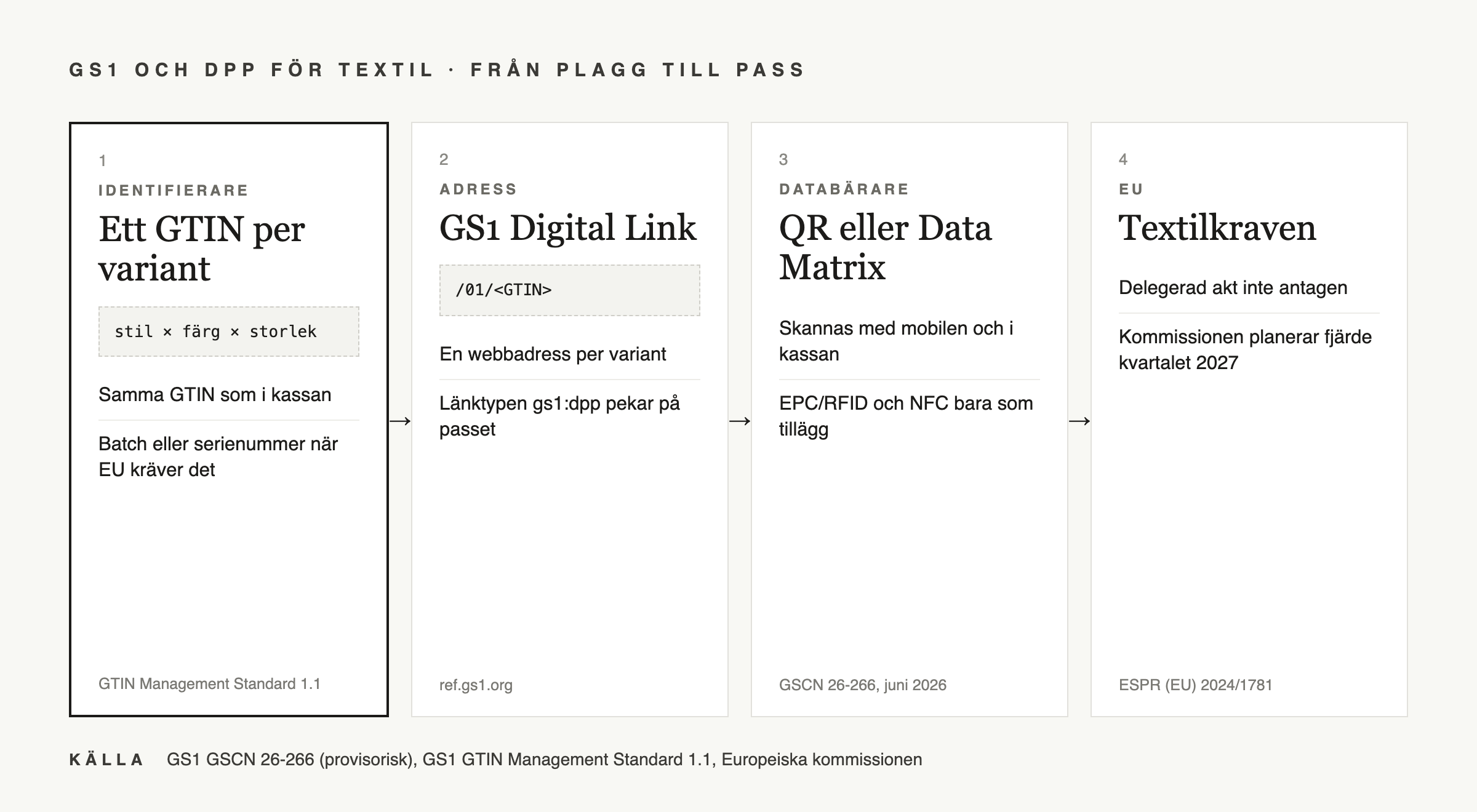
GS1 and DPP for Textiles: GTIN, Digital Link and QR
GS1's answer to the Digital Product Passport (DPP) for textiles is to use the GTIN a garment already has as the passport's unique product identifier, with a batch or serial number added when the EU requires it, and to put it in a QR code or Data Matrix using GS1 Digital Link. Under GS1's rules every combination of style, colour and size has its own GTIN. RFID may be used, but only in addition to the 2D code. The requirements for textiles themselves come in a delegated act the Commission plans to adopt in the fourth quarter of 2027.
What does GS1 say about digital product passports?
GS1 has a provisional application standard for products that need a DPP under the Ecodesign for Sustainable Products Regulation (ESPR), Regulation (EU) 2024/1781. The latest version is GSCN 26-266, release 2, from June 2026. It is explicitly not ratified: everything in it can change before it becomes a GS1 standard. It nevertheless sets out how GS1 sees identification and data carriers for the passport, and it is the closest thing to an official GS1 position.
Three things in it apply directly to textiles:
- The product is identified with a GTIN. The standard states that the unique product identifier in the GS1 system shall be the GTIN, possibly with a version, batch or serial number depending on what the rules for the product group require.
- Companies and factories are identified with a GLN. The economic operator and the facility where the product was made each get a Global Location Number.
- The address is a GS1 Digital Link. The full URI, with the brand's domain before the GS1 identifier, gives access to the public part of the passport without the consumer installing anything. Because the identifier sits in the address in a structured way, systems can parse it and reach restricted data and the back-up copy of the passport.
How the address is built step by step is covered in our article on GS1 Digital Link and DPP.
GS1 Sweden points to the same foundation. Its page on digital product passports recommends 2D codes, QR and Data Matrix, so that the same code can be scanned with a phone, at the checkout and by everyone in the logistics chain, and highlights GS1 Digital Link as especially relevant for passports.
One GTIN per colour and size
This is where textiles differ most from other sectors. In a PLM system a model or style is often one design that comes in several colours and sizes, with an SKU per variant. GS1's GTIN Management Standard (version 1.1, ratified in September 2023) gives a jeans example: in a new jeans line with several sizes of a given style and colour, each combination of style, colour and size is a unique product and gets its own GTIN.
For the passport this means:
- The GTIN level is already the variant level. A passport at GTIN level covers one colour in one size, not the whole style.
- Data that differs between sizes lands in the right place. The JRC study on DPP content for textiles (May 2026) notes precisely that weight can differ between sizes of the same style, and that the GS1 model treats each variant as a separate product.
- A GTIN is never reused. Under GS1's rules a GTIN is never assigned to another item, which is what makes
/01/<gtin>last as a passport address for the garment's whole life, including on the second-hand market.
If your garments carry an EAN barcode today, they already have GTINs. What is often missing is not the number but its use as an address.
Model, batch or item for textiles?
ESPR leaves it to the delegated act to decide whether the passport is set up per model, batch or item (Article 9(2)(d)). For textiles this has not been decided. The JRC study proposes definitions worth knowing:
| Level | JRC proposal | GS1 identifier |
|---|---|---|
| Model | All units share the same technical characteristics, pattern and construction, not necessarily distinguishing colour and size | GTIN, AI (01) |
| Batch | A subset of a model, made in the same plant at the same time under the same conditions | GTIN + batch, AI (10) |
| Item | A single unit of a model | GTIN + serial number, AI (21) |
The study also finds that most actors today handle product data at model level externally, that batch level is common internally, and that item level is seen as relevant but should be phased in. Some actors, particularly in luxury, prefer to invest in item-level identifiers from the start and fill them with batch- or model-level data until more is available. The JRC calls this an inheritance model.
GS1's provisional standard says the same from the identifier side: the delegated acts set the minimum level, and it can differ between life-cycle stages. A GTIN may be enough for selling online, while a GTIN plus serial number is needed to attest a repair. The standard also mentions AI (22), the GTIN version number, for changes that affect passport data but do not require a new GTIN.
How to choose between the levels is explained in the Academy episode Model, batch or item.
Which data carrier: QR, Data Matrix or RFID?
GS1's provisional standard allows three data carriers for the passport:
- QR code with GS1 Digital Link.
- Data Matrix with GS1 Digital Link.
- EPC/RFID, but only in addition. When RFID is used, it shall be in addition to a QR code or Data Matrix. The tag carries an SGTIN, a GTIN plus serial number, and the serial number must be exactly the same as in the barcode.
NFC may also be used in addition to the 2D code. The standard stresses that the delegated acts ultimately decide which data carriers are allowed per product group.
For textiles RFID is of particular interest, because many brands already have tags in their garments for stock and checkout. The JRC study notes that garments with RFID or NFC tags for the passport are not considered e-textiles and therefore do not fall outside the scope. GS1 Sweden describes EPC/RFID as a solution for traceability and stock visibility. But in GS1's position the tag does not replace the 2D code: the consumer must be able to reach the passport with a phone camera.
Where does the code go on a garment?
ESPR requires the data carrier to be physically present on the product, its packaging or documentation accompanying it, as the delegated act specifies. The act may also set how long the code must remain readable. GS1's standard is clearer about the order: on the product first, and on packaging or documentation only if that is not possible or practical.
For a garment this in practice means the care label or a woven label, since a hangtag is removed. Our article on DPP requirements for textiles covers placement and the data that is expected.
GS1's standard also recommends one code for several purposes where possible: the same 2D code for the checkout, logistics, the passport and customer engagement.
When do the requirements apply to textiles?
Not yet. On 9 November 2026 there is no adopted delegated act for textiles. The Commission's page on textiles and the DPP gives the fourth quarter of 2027 as the planned adoption, with guidance and technical specifications to follow, and notes that the timeline may change. The content is decided in the act. The Commission lists, among other things, product identification, fibre composition under the Textile Labelling Regulation where relevant, information on use and repair, origin and the economic operators.
What already exists are the harmonised standards. GS1 Sweden writes that they were published in May 2026. EN 18219 covers unique identifiers and EN 18220 data carriers. Our article on EN 18216 to 18223 explains what each standard requires.
What can a textile brand do now?
- Check GTIN coverage. Does every combination of style, colour and size have its own GTIN, and is it used in every channel?
- Get GLNs for the company and the factories. GS1's standard uses the GLN for the economic operator and the manufacturing facility.
- Decide the identifier level. Even if the passport starts with model data only, a QR code with a batch or serial number can be printed now.
- Put the address on your own domain. A GS1 Digital Link on the brand's domain survives a change of platform.
- Mark the passport as a passport. GS1's link type
gs1:dppsays the link leads to a digital product passport. - Test on real labels. Scan the code at printed size, on the material it will be attached to.
The Academy episode From a GTIN list to QR codes shows how a range with GTINs becomes print-ready codes.
How DPP Agent handles GS1 for textiles
- Addresses at all three levels. Passports at
/01/<gtin>, with/10/for batch and/21/for serial number, on the brand's own domain. - Inheritance between levels. An item passport inherits model and batch data, so only the serial number needs to be given per garment.
- Checks against the standards. The DPP validator checks a passport address against EN 18216 and EN 18219–18223.
The Academy episode on textiles covers the rest of the textile passport.
Frequently asked questions
Does GS1 require a GTIN for the textile passport?
Within the GS1 system, yes: the provisional DPP standard names the GTIN as the product identifier. The EU, however, does not require GS1. ESPR and EN 18219 require a unique identifier under ISO/IEC 15459, and GS1 is one of several accepted schemes.
Does every size need its own passport?
Every size has its own GTIN under GS1's rules, so a passport at GTIN level covers one colour in one size. Data that is the same for the whole style can still be managed once and inherited by the variants.
Is an RFID tag in the garment enough?
Not under GS1's provisional standard. EPC/RFID may be used, but only in addition to a QR code or Data Matrix with GS1 Digital Link. Which data carriers are finally allowed for textiles is decided in the delegated act.
When does the textile passport become mandatory?
The Commission plans to adopt the delegated act for textiles in the fourth quarter of 2027. The date the requirements start to apply is set in the act.
Is GS1's DPP standard final?
No. GSCN 26-266 is a provisional standard, release 2 from June 2026, and GS1 states explicitly that it is not ratified and may change.
Sources
- Regulation (EU) 2024/1781 (ESPR): Article 9(2)(d) (model, batch or item) and Article 10(1) (data carrier, unique product identifier and where the data carrier must be). EUR-Lex
- GS1, GSCN 26-266: provisional DPP application standard, release 2, June 2026, not ratified. ref.gs1.org
- GS1, GTIN Management Standard 1.1: ratified September 2023, the new product introduction rule with the jeans example. ref.gs1.org
- GS1, link types:
gs1:dpp. ref.gs1.org - JRC, Study on DPP content for textile apparel products under ESPR (May 2026): sections 5.2.3 and 9.1 on granularity. JRC Product Bureau
- European Commission, Textile Apparel and the Digital Product Passport: planned adoption in the fourth quarter of 2027. Commission page
- GS1 Sweden, Digital product passports. gs1.se