Digital Product Passport in Spain: Rules and Authorities
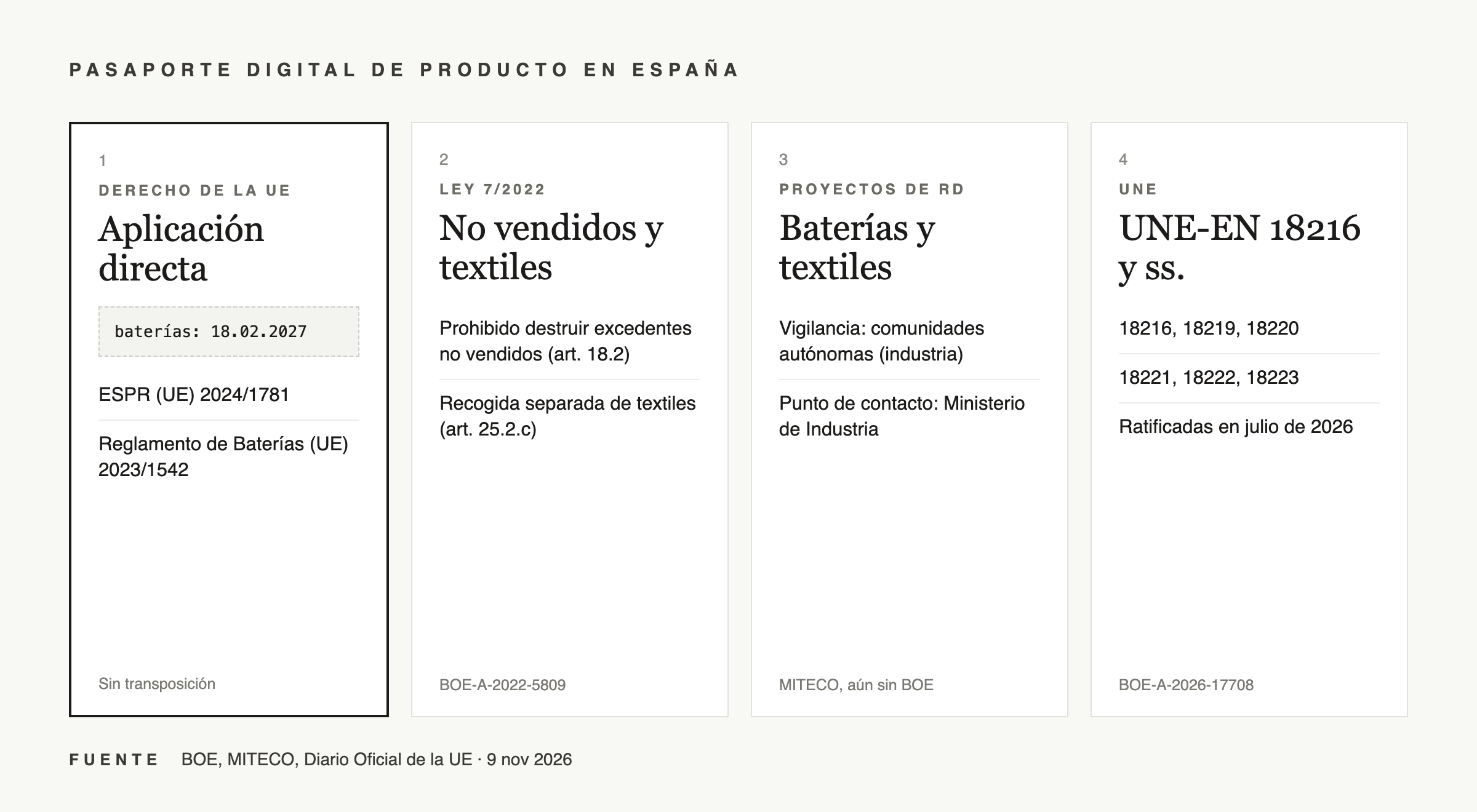
In Spain the digital product passport follows directly from EU regulations, not from a Spanish law. The Ecodesign Regulation (EU) 2024/1781 and the Battery Regulation (EU) 2023/1542 apply without transposition, and the first obligation is the battery passport from 18 February 2027. What Spain adds is the surrounding framework: Ley 7/2022 on waste has banned the destruction of unsold non-perishable products since 2022, a draft royal decree on batteries names the authorities that will supervise, and the passport standards have been ratified as UNE-EN 18216 and following since July 2026. We found no Spanish provision implementing the Ecodesign Regulation itself.
Which law requires a product passport in Spain?
A regulation of the European Union applies in every Member State on its own. Spain does not have to transpose the Ecodesign Regulation (ESPR) or the Battery Regulation for the passport to be required. ESPR itself requires a passport for no product. That happens in a delegated act per product group, and as a rule at least 18 months pass between the act entering into force and its application (Article 4(4)). The general timeline is in ESPR Compliance Timeline
The Battery Regulation is different: its Article 77(1) sets the date itself. From 18 February 2027 every LMT battery, every industrial battery above 2 kWh and every electric vehicle battery placed on the market needs a passport. More in EU Battery Passport: Requirements and Deadlines.
What Member States do have to do is designate authorities and set penalties. For ESPR we found no Spanish act, draft or public consultation on the Boletín Oficial del Estado (BOE) or the websites of the Ministry for the Ecological Transition (MITECO) and the Ministry of Industry and Tourism. That does not mean none is being prepared, only that none had been published.
Batteries: who will supervise in Spain
MITECO held a public consultation on a draft royal decree on batteries and their waste from 30 June to 3 September 2026. The decree is to apply the Battery Regulation in Spain and replace the current Real Decreto 106/2008. It has not yet been published in the BOE.
In the draft:
- Market surveillance for the Battery Regulation lies with the authorities of the autonomous communities responsible for industry (Article 4).
- The Ministry of Industry and Tourism is the contact point with the European authorities and the notifying authority for conformity assessment bodies (Articles 4 and 9).
- The battery passport is mentioned only in the preamble, as one of the new features of the EU regulation. The decree does not regulate it further, because the regulation already does.
For a battery manufacturer this means that the inspection of a battery placed on the market in Spain will in principle be carried out by the industry department of the autonomous community, while the content of the passport is set by EU law.
Ley 7/2022: unsold products and textiles
Spain did not wait for the EU on two points that the Ecodesign Regulation also addresses.
- Destruction of unsold products. Article 18.2 of Ley 7/2022 on waste and contaminated soils prohibits destroying or landfilling unsold surplus of non-perishable products such as textiles, toys or electrical appliances, unless another rule or consumer protection and safety require it. The EU ban on destroying unsold apparel and footwear comes on top of that.
- Separate collection of textiles. Under Article 25.2.c, local authorities had to set up separate collection of textile waste before 31 December 2024.
- Producer responsibility for textiles. The law gave three years from its entry into force to set up extended producer responsibility for textiles. MITECO held a consultation on a draft royal decree on textile and footwear products and their waste from 1 July to 4 September 2025. We found no publication in the BOE.
Neither rule creates a passport. But the data that an extended producer responsibility scheme needs, such as composition and quantities placed on the market, overlap with what a textile passport will ask for. See Digital Product Passport Requirements for Textiles.
UNE-EN 18216 and following: the standards in Spanish
The Spanish Association for Standardisation (UNE) ratified six European passport standards in July 2026. A resolution published in the BOE on 13 August 2026 (BOE-A-2026-17708) lists them:
| Standard | Subject |
|---|---|
| UNE-EN 18216:2026 | Data exchange protocols |
| UNE-EN 18219:2026 | Unique identifiers |
| UNE-EN 18220:2026 | Data carriers |
| UNE-EN 18221:2026 | Data storage, archiving and persistence |
| UNE-EN 18222:2026 | Application programming interfaces (APIs) |
| UNE-EN 18223:2026 | System interoperability |
The same six were cited in the Official Journal of the EU on 15 July 2026 by Implementing Decision (EU) 2026/1736. A passport built to them is presumed to conform to the corresponding requirements of ESPR. More in CEN/CENELEC DPP standards.
What companies in Spain can do now
- Batteries first. If you place LMT, industrial batteries above 2 kWh or electric vehicle batteries on the market, the passport is needed from 18 February 2027, decree or no decree.
- Name the standards when you choose a system. Ask for UNE-EN 18216 and following by number and edition.
- Treat unsold stock as a data question. Article 18.2 of Ley 7/2022 already applies. Record what happens to unsold products.
- Prepare textile data with the EPR in mind. Composition and quantities serve both producer responsibility and the coming passport.
- Check what you already have. The validator checks a passport against the EN standards and the EU registry's data model. A worked example is in Digital Product Passport Example: What a Passport Shows.
Frequently asked questions
Is the digital product passport mandatory in Spain?
Yes, where EU law requires it, because EU regulations apply directly. The first obligation is the battery passport from 18 February 2027. For other products it starts when the delegated act for their product group applies.
Is there a Spanish law on the digital product passport?
We found none. Spain has published no provision implementing the Ecodesign Regulation. The draft royal decree on batteries mentions the battery passport only in its preamble.
Who supervises the battery passport in Spain?
According to the draft royal decree on batteries, market surveillance lies with the autonomous communities' industry authorities, and the Ministry of Industry and Tourism is the contact point with the EU. The decree has not yet been published in the BOE.
Does Spain already ban destroying unsold products?
Yes. Article 18.2 of Ley 7/2022 prohibits destroying or landfilling unsold surplus of non-perishable products such as textiles, toys or electrical appliances, with exceptions.
Which UNE standards apply to the digital product passport?
UNE-EN 18216, 18219, 18220, 18221, 18222 and 18223, all from 2026, ratified by UNE in July 2026.
Sources
- Regulation (EU) 2024/1781 (ESPR): Article 4(4). EUR-Lex
- Regulation (EU) 2023/1542 (Battery Regulation): Article 77(1). BOE (Official Journal)
- MITECO, public consultation on the draft royal decree on batteries and their waste, 30 June to 3 September 2026. MITECO
- Ley 7/2022, de residuos y suelos contaminados para una economía circular: Articles 18.2 and 25.2.c, final provision seven. BOE
- MITECO, public consultation on the draft royal decree on textile and footwear products and their waste, 1 July to 4 September 2025. MITECO
- Resolution of 2 August 2026 on standards ratified by UNE in July 2026, BOE of 13 August 2026. BOE
- Commission Implementing Decision (EU) 2026/1736. BOE (Official Journal)