The expensive part of product passports is not the platform, unless you build it yourself
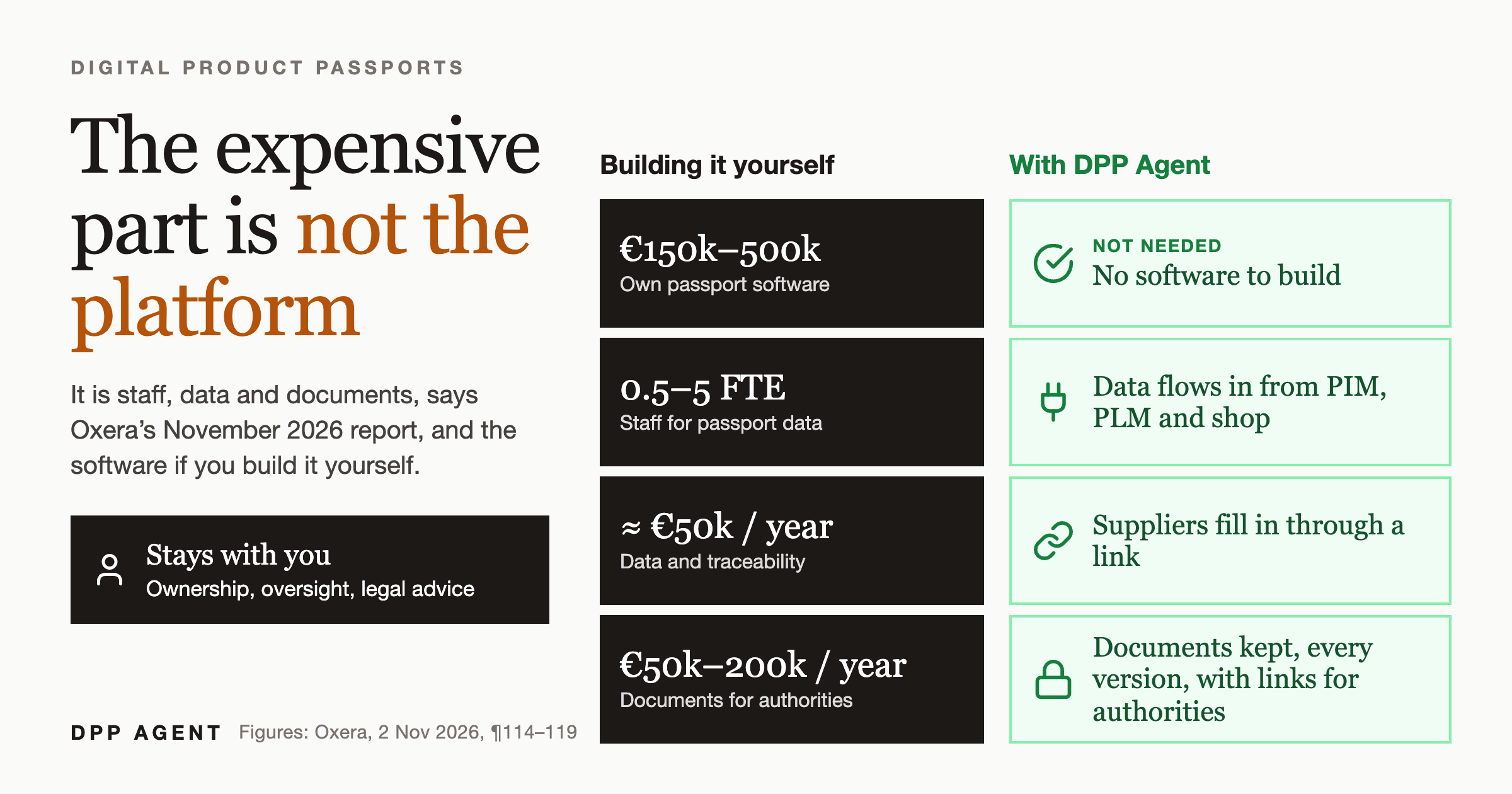
The cost of a compliant digital product passport lies in staff, development, data and documents. On 2 November 2026 Oxera published a cost assessment for the EU, commissioned by Amazon. It puts staff at 0.5 to 5 additional full-time positions per company in a detergent-sector study (paragraph 119), in-house passport software at €150,000 to €500,000 one-off for larger firms (paragraph 114), and data preparation at around €50,000 a year for a medium-sized fashion company (paragraph 117). These costs grow with the number of passports and the level they are kept at. DPP Agent takes away the manual data entry and the software build. Legal advice, oversight and ownership of the data stay with the company (paragraph 132).
Where the cost is, according to Oxera
The report, Assessment of costs associated with enabling Digital Product Passports in the EU, draws on consultation submissions, pilot projects and interviews with companies, passport service providers and industry associations. Section 4.7 collects the cost estimates. The report notes they are not a harmonised data set, but directionally consistent.
Where the cost of passports is, according to Oxera
Built yourself, the cost sits in staff, software, data and documents.
With DPP Agent, the work moves from people to connections.
0.5–5 FTE
Staff for passport data, per company
€50k–500k a year · paragraph 119
With DPP Agent: 0.5–5 FTE · paragraph 119
Product data flows in from your PIM, PLM and shop
No retyping between systems.
€150k–500k
Building your own passport software, one-off
Larger firms · paragraph 114
With DPP Agent: €150k–500k one-off · paragraph 114
Not needed
No passport software to build
Address, JSON, API and checks are in place.
≈ €50k a year
Data preparation and traceability
Medium-sized fashion company · paragraph 117
With DPP Agent: ≈ €50k a year · paragraph 117
Suppliers fill in their part through a shared link
Their answers land straight in the passport.
≈ €25k a year
Environmental performance data
Same company · paragraph 117
With DPP Agent: ≈ €25k a year · paragraph 117
Missing values proposed with their source, a person approves
Measuring the figures stays with you.
€50k–200k
Authority access to technical documentation
A year, external costs, depends on interpretation · paragraph 118
With DPP Agent: €50k–200k a year · paragraph 118
Documents stored with access links for authorities
Every version kept, with who, when and from where.
Stays with you whichever way you build
Legal advice, oversight of the data and connecting your own systems. Paragraph 132.
Bars: one linear scale from €0 to €500k. Dark: a single figure or the low end of a range.
All figures, sources and details as a table
| Cost item | Amount | Paid | Source | What it covers | What DPP Agent reduces | What stays with you |
|---|---|---|---|---|---|---|
| Staff: 0.5 to 5 full-time positions at €100,000 each (IKW study) | €50,000 to €500,000 | Per year | Paragraph 119 | Data management and governance, regulatory compliance monitoring, supplier engagement and onboarding, and technical integration with DPP platforms and systems such as ERP and PLM. The study assumes €100,000 per position per year in Germany. | Product data is fetched from PIM, PLM, ERP and shop systems through integrations instead of being typed in. AI proposes missing values with their source, and a person approves each one. Suppliers answer through a shared link. | Ownership of the data, compliance decisions and ongoing oversight. The report says personnel remains whichever provider is used (paragraph 132). |
| In-house passport software, larger firms | €150,000 to €500,000 | One-off | Paragraph 114 | One-off development of DPP software, as estimated by interviewees for larger firms. The report expects modest costs for smaller firms with simple systems. | Nothing to build: the GS1 Digital Link address, JSON, the read methods of EN 18222, version history, checks per product group and, for batteries, the export in the EU registry's format are in place. | Connecting your own systems, which the report counts as system integration (paragraph 132). |
| Data preparation and traceability, medium-sized fashion company | around €50,000 | Per year | Paragraph 117 | Preparing product data and traceability for one medium-sized European fashion company, from an interview. The report adds that data must be maintained as supply chains, staff and products change. | Data is read where it already lives, and changes in the source system come back as proposals for a new version. What only the supplier or factory knows is entered by them through the supplier link. | The supply-chain information itself, which only you and your suppliers have. |
| Environmental performance data, same company | around €25,000 | Per year | Paragraph 117 | Environmental performance data for the same fashion company, from an interview. | Values that exist in your systems or with your suppliers are collected and shown with their source. | Measuring or calculating the figures. DPP Agent does not invent environmental data. |
| Authority access to technical documentation, external services (IKW study) | €50,000 to €200,000 | Per year | Paragraph 118 | Protected access for authorities to technical documentation and conformity-assessment material, with additional personnel costs of €300,000 to €500,000 a year on top. The report says these figures depend on how the requirement is interpreted and are not a baseline for data collection. | Certificates and documents are kept with the passport, every version is archived with who changed what and when, and restricted data is shared with authorities through a link of their own. | Deciding what the technical documentation contains, and legal advice (paragraph 132). |
| External consulting for implementation, on average | €30,000 to €50,000 | One-off | Paragraphs 120 and 121 | One-off process and project-management work, implementation, architecture design and strategy. | The standards are built in, and the validator shows field by field what each product lacks against the regulation for its product group. | Legal advice and decisions on scope (paragraph 132). |
The costs grow with volume and granularity. The report says that variable costs scale with production volume, batches, SKUs and the level the regulation requires (paragraph 49), and that identification at model, batch or item level is a key cost determinant (paragraph 96). A model-level passport covers every unit of a product; an item-level passport is one per unit, as for the batteries in Article 77(1) of the Battery Regulation, which multiplies passports, versions and registrations. Stored documents add to it: for authority access to technical documentation, the IKW study cited in paragraph 118 puts external costs at €50,000 to €200,000 a year, plus staff, and the report notes that the figure depends on interpretation. Versions and the backup copy grow with every change.
Staff is the most reliable figure. The detergent-sector study by IKW assumes 0.5 to 5 additional permanent full-time positions per company, at €100,000 each a year in Germany. Oxera calls this the evidence that is "most plausible and most transferable across sectors", because keeping product data accurate across a live supply chain is work done by people.
Data preparation dominates the effort. A practitioner at the World DPP Summit in Berlin in March 2026, quoted in the report, put about 90% of the effort in data preparation.
Share of DPP effort, practitioner estimate
- Data preparation 90%
- Publication 5%
- Maintenance 3%
- Archival 2%
On the Commission's own figures for toys, Oxera finds a benefit-cost ratio of 1.6. A 20% increase in variable costs brings it down to 1.3. Small companies and less digitally mature firms are expected to carry relatively higher costs, because fixed costs weigh more on low volumes.
The compliance checklist
A passport that meets the Ecodesign for Sustainable Products Regulation, Regulation (EU) 2024/1781 (ESPR), and the harmonised standards has to pass seven checks. A company that builds its own passport software builds each of them, which is part of the development cost in paragraph 114.
Seven checks for a compliant passport
Address
GS1 Digital Link · EN 18219 · ESPR Article 10(1)
Does the passport answer at an identifier EN 18219 accepts, on the brand's own domain?
Machine-readable data
EN 18216 · EN 18222 · ESPR Article 11(a)
Does it return JSON when a system asks, and answer the API calls the standard requires?
Versions
EN 18221 · ESPR Article 11(f) and (g)
Is every version kept, with who changed what and when?
Backup host
EN 18221 · ESPR Articles 10(4) and 11(e)
Is there a copy with a passport service provider, so the passport outlives its publisher?
Registration
ESPR Article 13(4) · Implementing Regulation (EU) 2026/1778
Does the service register the passport in the EU registry through its API?
Updates
EN 18222 lifecycle API · ESPR Article 13(4)
When source data changes, do the passport and its registration follow without work passport by passport?
The right regulation
ESPR Article 4 delegated acts · Regulation (EU) 2023/1542 for batteries
Is the passport checked against the rules for its own product group?
1. The address: GS1 Digital Link and EN 18219
ESPR Article 10(1) requires the passport to be connected through a data carrier to a persistent unique product identifier. EN 18219 lists the identifier schemes it accepts. GS1 Digital Link is one of them: a web address that carries the GTIN after /01/. Check that the address works on the brand's own domain, so it stays with the brand if it changes service. Our article on GS1 Digital Link for DPP covers the format, and the GS1 Digital Link tool builds the links.
2. Machine-readable data: EN 18216 and EN 18222
A passport is read by systems as well as by people. EN 18216 covers how passport data is exchanged, and JSON is its mandatory format; the EU registry requests JSON when it fetches a passport. EN 18222 defines the API, including three read methods a passport must answer: by passport ID, by product ID and for a list of product IDs. ESPR Article 11(a) requires passports to be fully interoperable. A service that only returns a web page fails this check. The article on the six harmonised standards explains what each covers.
3. Versions
ESPR Article 11, point (f), restricts who may change passport data, and point (g) requires data authentication, reliability and integrity. EN 18221 covers archiving. Every version should be kept, with who changed what and when, so you can show what the passport said on a given date.
4. The backup host: EN 18221
ESPR Article 10(4) requires the economic operator to make a back-up copy of the passport available through a digital product passport service provider. Article 11(e) requires the passport to remain available after an insolvency, a liquidation or a cessation of activity. EN 18221 describes the backup host that holds that copy. Ask where the copy is, and who runs it.
5. Registration in the EU registry
ESPR Article 13(4) requires the economic operator placing the product on the market to upload the passport's identifiers to the registry. The Commission published the registry API on 30 October 2026. According to the DPP Helpdesk, production is targeted for the end of January 2027. Batteries come first: the passport obligation applies from 18 February 2027 to LMT batteries, industrial batteries above 2 kWh and EV batteries. Our article on battery passport registration walks through the API.
6. Updates
Suppliers, materials and care instructions change. Ask whether a change in your own system reaches the passport and its registration without editing passports one by one, and whether each change leaves a version.
7. The right regulation
Requirements are set per product group: ESPR delegated acts under Article 4 for textiles, furniture or tyres, and the Battery Regulation, Regulation (EU) 2023/1542, for batteries. A passport complete for one group can be incomplete for another. Check that each product is graded against its own rules.
What DPP Agent reduces, and what it does not
DPP Agent works on the cost items above. For each, this is what changes and what stays.
Staff and data: integrations instead of manual entry. Passports are filled from the systems where the data already lives. Connectors include Akeneo, inRiver, Shopify, Centra, Magento, WooCommerce, commercetools, Dynamics 365, Delogue and BeProduct, as well as CSV files, Google Sheets and EPREL for tyres; the integrations page lists them all. Typing product data from PLM and PIM into a passport goes away.
Gaps: AI proposals with a source, approved by a person. Where a value is missing, AI proposes one with its source shown, and a person approves it before anything is written. DPP Agent does not invent values, so data that does not exist yet, such as measured environmental figures, still has to be produced.
Suppliers: the supplier link. What only a supplier or factory knows is asked through a shared link, and the answer lands in the passport.
Documents and versions: an archive that keeps itself. Certificates and documents are kept with the passport, every change is saved with who, when and where from, and authorities get restricted data through a link of their own.
The registry: export and registration. For batteries, passports can be exported in the EU registry's format, and registration through the registry's API is connected when its production environment opens.
Development: nothing to build.
- an address under GS1 Digital Link, on the brand's own domain
- machine-readable JSON and the read methods of EN 18222
- version history, with who changed what and when
- checks against ESPR and the harmonised standards EN 18216 and EN 18219 to EN 18223, per product group
- for batteries, an export in the EU registry's format; registration through the registry's API is connected when its production environment opens
- updates that follow the source system: the sync picks up a change, and it becomes a new version of the passport once a person has approved it
- a backup host under EN 18221, holding a copy of every passport with an independent host, in operation from 1 February 2027
The right regulation per product. Batteries, textiles, footwear, furniture, tyres, detergents and construction products are handled on one platform, each checked against its own rules.
What stays with the company. Oxera writes that personnel, legal advice, system integration and ongoing operational oversight remain necessary whichever provider is used (paragraph 132). That holds here too: someone owns the data and the compliance decisions, legal questions need legal advice, and connecting your own systems is still work.
Run the validator
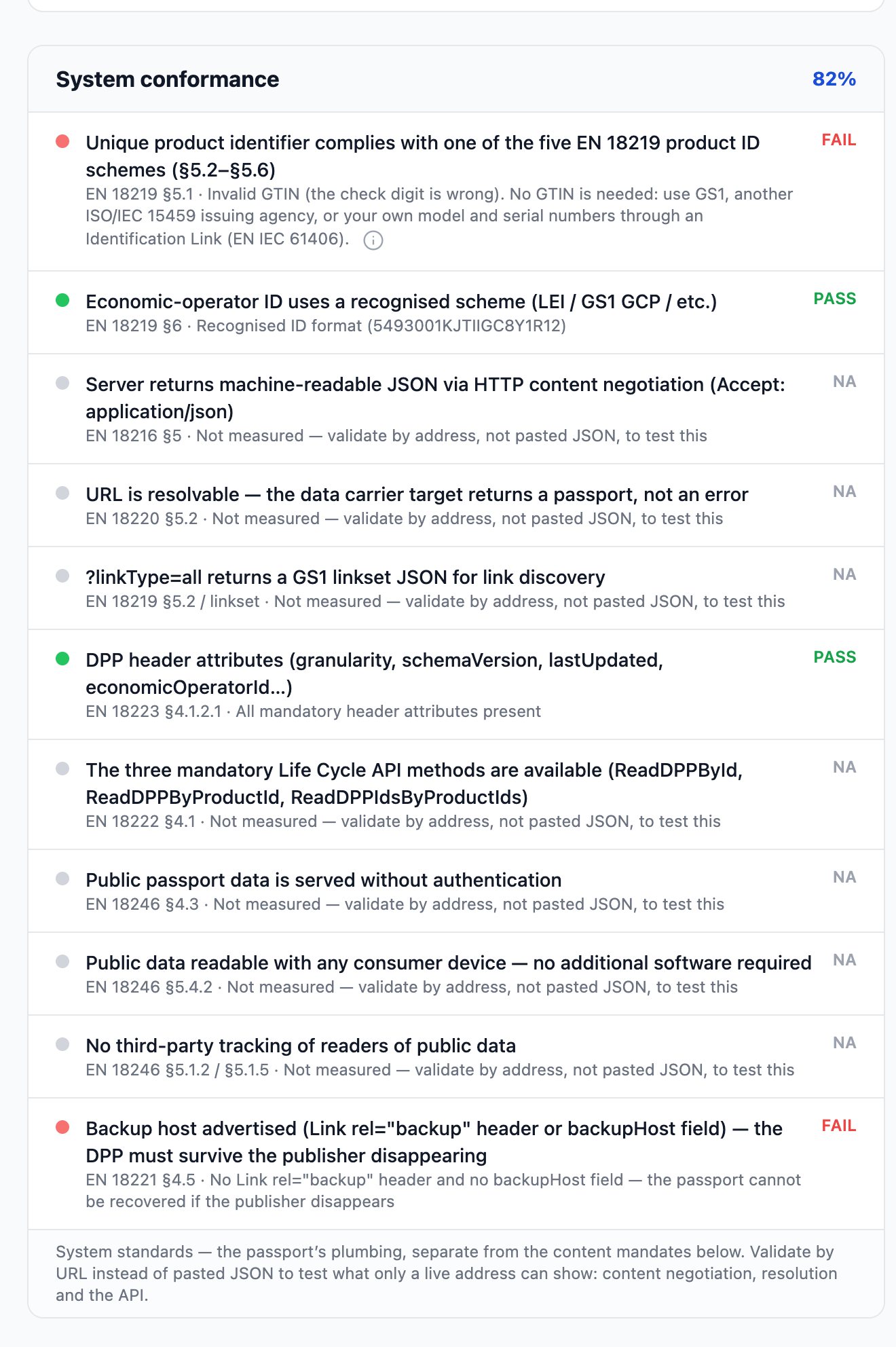
The DPP validator checks a passport against the checklist above, whoever built it. Paste a passport URL or JSON, and it reports what is present and what is missing, field by field and standard by standard. A URL also tests what only a live address can show: content negotiation, resolution and the API.
Run one of your own products through it to see what is missing. The DPP Academy episode on the EU registry explains what is registered and by whom.
Frequently asked questions
How much does a digital product passport cost?
Most of the cost lies in staff, development, data and documents. Oxera's report of 2 November 2026 puts staff at 0.5 to 5 full-time positions per company, €50,000 to €500,000 a year in the IKW study (paragraph 119), in-house software at €150,000 to €500,000 one-off for larger firms (paragraph 114), and data preparation and traceability at around €50,000 a year for a medium-sized fashion company (paragraph 117). The report says that variable costs scale with production volume, batches, SKUs and the level the regulation requires (paragraph 49), and that identification at model, batch or item level is a key cost determinant (paragraph 96). What a company's passports cost depends on:
- Volume: how many passports, from the number of products and variants and how many are new each season.
- Granularity: model, batch or item. Item-level means one passport per unit, and so many times more passports, versions and registrations. The Battery Regulation requires a passport for each LMT battery, each industrial battery above 2 kWh and each EV battery (Article 77(1)).
- Documents: whether certificates, technical documentation and test reports are stored, with controlled access for authorities. For authority access to technical documentation, the IKW study cited by Oxera estimates €50,000 to €200,000 a year in external costs plus staff, and the report says the figure depends on interpretation (paragraph 118).
- Versions and backup: every change is kept and a copy is held with an independent host, so storage grows over time.
- Registration: each passport is registered in the EU registry and updated there.
Personnel, legal advice, system integration and oversight remain whichever provider is used (paragraph 132).
What makes a digital product passport compliant?
An identifier EN 18219 accepts, such as GS1 Digital Link; JSON and the API under EN 18216 and EN 18222; kept versions; a back-up copy with a passport service provider (ESPR Article 10(4)); registration in the EU registry (ESPR Article 13(4)); updates; and checks against its product group's regulation.
When can passports be registered in the EU registry?
The Commission published the registry API on 30 October 2026. According to the DPP Helpdesk, production is targeted for the end of January 2027. The battery passport obligation applies from 18 February 2027.
How can I check whether a passport complies?
Run it through the DPP validator at dppagent.com/validate. It checks the passport against ESPR, the harmonised standards and its product group's regulation, and lists what is missing.
Sources
- Oxera, Assessment of costs associated with enabling Digital Product Passports in the EU, 2 November 2026, prepared for Amazon: executive summary; paragraphs 49 and 96; section 4.7, paragraphs 114 to 122; paragraph 132; section 6.6. Oxera
- Regulation (EU) 2024/1781 (ESPR): Article 4, Article 10, paragraphs 1 and 4, Article 11 and Article 13(4). EUR-Lex
- Regulation (EU) 2023/1542 (Battery Regulation): Article 77(1). EUR-Lex
- Commission Implementing Regulation (EU) 2026/1778 on the digital product passport registry. EUR-Lex
- European Commission, DPP resources and documentation: registry API documentation, 30 October 2026. Commission page
- CEN/CENELEC JTC 24: EN 18216, EN 18219, EN 18221 and EN 18222 (2026). CEN/CENELEC
- DPP Helpdesk: answer of 4 November 2026 on the availability of the registration API.