Battery Passport Access Rights: Who Sees What from 2027
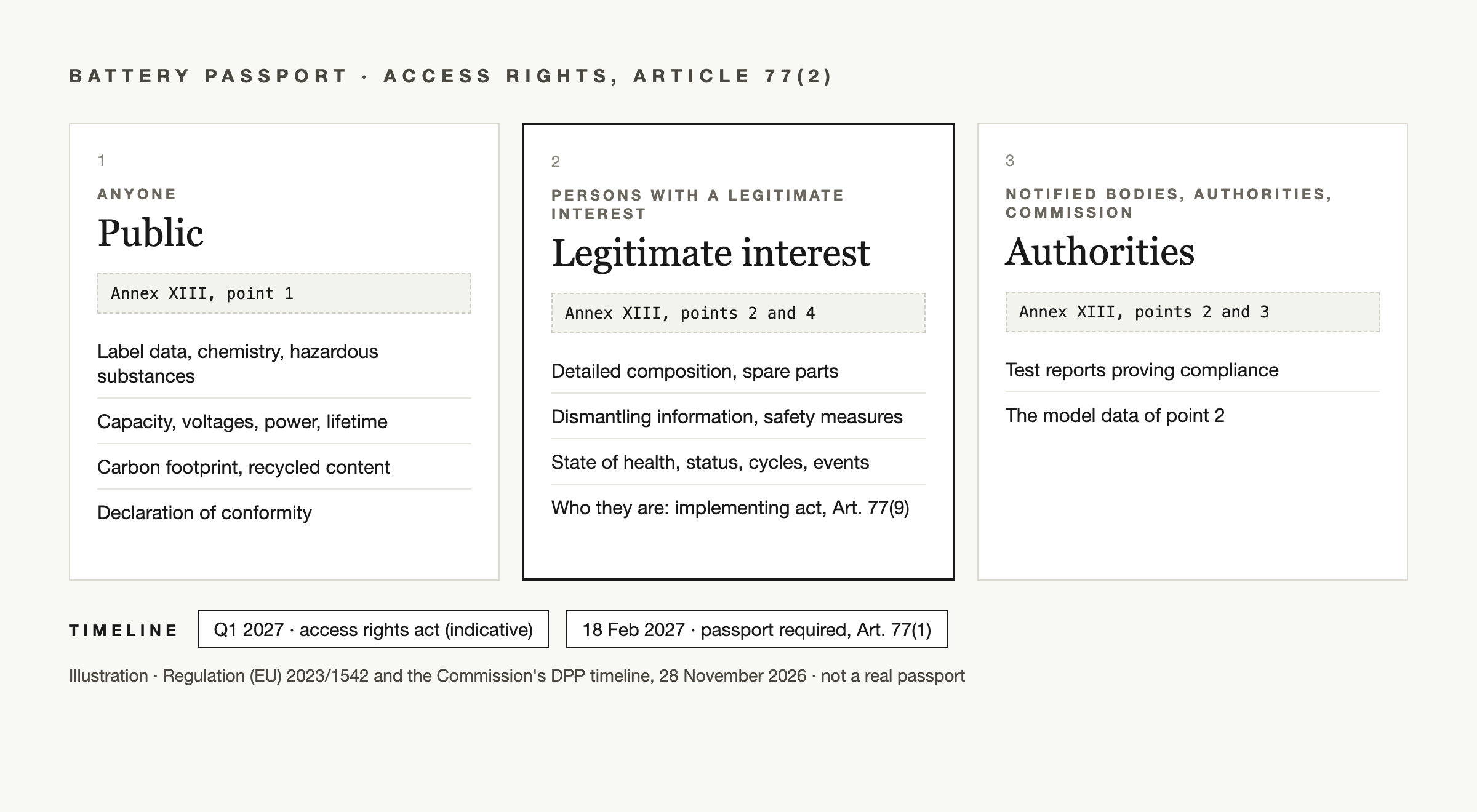
Battery passport access rights decide who may read the restricted parts of a battery passport, and what they may do with that data. The Battery Regulation already sets three levels of access in Article 77(2): the public, persons with a legitimate interest, and the authorities. Which persons count as having a legitimate interest is left to a Commission implementing act under Article 77(9). The Commission's timeline now places that act in Q1 2027. The passport itself applies from 18 February 2027.
What changed on the Commission's timeline
The Commission's Digital Product Passport page keeps an indicative timeline of the acts still to come. On 28 November 2026 it read:
| Timeline entry | What it says |
|---|---|
| Q4 2026 | Delegated act for iron and steel |
| Q1 2027 | Implementing act for battery access rights |
| 18 February 2027 | DPP mandatory for EV, LMT and industrial batteries |
| Q2 2027 | Delegated act for DPP service providers; delegated act for construction products under the CPR |
| Q3 2027 | Guidelines for DPP service providers |
Earlier versions of the same timeline placed the battery access rights act in Q4 2026, together with iron and steel. The Q3 2027 entry for service providers also changed: it used to name a delegated act and now names guidelines. The delegated act for service providers is still listed for Q2 2027.
The Regulation itself set an earlier date. Article 77(9) says the Commission "shall adopt" the implementing acts by 18 August 2026. That date has passed without adoption.
The three access levels in Article 77(2)
Article 77(1) of the Battery Regulation, Regulation (EU) 2023/1542, requires a passport from 18 February 2027 for each LMT battery, each industrial battery with a capacity above 2 kWh and each electric vehicle battery. Portable and SLI batteries are not covered. Article 77(2) then splits the content of each passport by who may read it:
| Level | Who may read it | Data, per Annex XIII |
|---|---|---|
| Public | Anyone | Point 1: the battery model's label data, material composition, carbon footprint, responsible sourcing, recycled and renewable content, capacity, voltages, power, lifetime, round-trip efficiency, internal resistance, the EU declaration of conformity and waste battery information |
| Legitimate interest | Persons with a legitimate interest, and the Commission | Point 2 (model): detailed composition of cathode, anode and electrolyte, part numbers and sources of spare parts, dismantling information and safety measures |
| Point 4 (individual battery): performance and durability values, state of health, status (original, repurposed, re-used, remanufactured or waste), and data from use such as charging cycles, negative events, temperature and state of charge | ||
| Authorities | Notified bodies, market surveillance authorities and the Commission | Point 3: the test reports that prove compliance, plus the point 2 data |
Article 77(2) also limits why a person with a legitimate interest may access the data. The purpose must either concern dismantling and the detailed composition of the battery model, essential for repairers, remanufacturers, second-life operators and recyclers, or, for an individual battery, be essential to its purchaser for making it available to independent energy aggregators or energy market participants.
Article 78(f) ties the technical design to these rules: the rights to access, introduce, modify or update information in the passport shall be restricted based on Annex XIII and the implementing act under Article 77(9).
What the implementing act will decide
Article 77(9) gives the implementing act three questions to answer:
- which persons are to be considered persons with a legitimate interest, for points 2 and 4 of Annex XIII
- which of the information in those points each of them may access
- to what extent they may download, share, publish and re-use it
The act must follow three criteria in Article 77(9): the need for the information to evaluate the status and residual value of the battery, the need for it in preparing re-use, repurposing, remanufacturing or recycling, and the need to limit access to commercially sensitive information to the minimum necessary. It is adopted under the examination procedure in Article 90(3), which means a vote by a committee of the Member States.
The act leaves the content of the passport as Annex XIII sets it and decides who may open the restricted parts.
Where the act stands
At the Commission's battery passport webinar on 26 November 2026, the Commission described the steps left:
- A draft was published on the Have your say portal and received 98 responses, which the Commission is going through.
- The Member States have been consulted.
- A consultation under the WTO Agreement on Technical Barriers to Trade (TBT) is open until 25 December 2026.
- After that, the committee of the Member States votes on the act, possibly in a modified form, and the Commission adopts and publishes it.
The Commission said it hopes to finish in January, before the passport applies in mid-February. It added that the act matters later in practice: passports are only required for batteries placed on the market from 18 February 2027, and the restricted information becomes necessary when those batteries are repaired, repurposed or recycled.
What a battery manufacturer can do before 18 February 2027
None of the following depends on the implementing act.
| Step | Source |
|---|---|
| List the batteries in scope: LMT, industrial above 2 kWh, EV | Article 77(1) |
| Collect the model data for points 1, 2 and 3 of Annex XIII, and plan how point 4 data is recorded per battery | Annex XIII |
| Mark every field with its access level, so the restricted data never appears on the public page | Article 77(2) |
| Decide who reads the restricted levels today: repairers, recyclers and authorities you already work with, by a link you can revoke | Article 77(2), Article 78(f) |
| Keep the passport available even if your company ceases to exist | Article 78(e) |
| Verify your organisation in the EU DPP Registry with a qualified electronic seal | Commission, User Guide for Economic Operators |
| Serve the restricted parts to the Registry when it reads the passport with its token | Commission, Self-Hosted Authentication Guide |
When the act is published, compare its list of persons and its limits on download, sharing and re-use with the access you have granted, and adjust the access. The passports themselves do not need to be issued again.
Our article on battery passport registration covers the Registry step in detail, and the one on verifying your company in the EU DPP Registry covers the seal.
What DPP Agent does with access levels
- Each field knows its level. Every field in the battery schema carries its Article 77(2) audience: public, legitimate interest or authorities.
- Restricted data is never sent without proof. Without proof of a role, a reader gets the public view, on the page and in JSON, JSON-LD and every export. The restricted fields are left out of the answer altogether.
- Access by role, with a link you control. You give a repairer, refurbisher or recycler a link to the legitimate-interest data, and a market surveillance or competent authority a link to the authorities' data. Each link is signed, expires and can be revoked, and each use is logged.
- The Registry reads its part. When the EU DPP Registry reads a passport with its own token, it gets the restricted data it needs to register it.
- Ready to adjust when the act lands. Which roles read which level is set in one place in the service, so it can follow the implementing act without changing your passports.
- Gaps before you register. The DPP validator shows what is missing in a passport against the Commission's schemas.
The DPP Academy episode on batteries covers the rest of the battery passport, and the battery passport article lists the data and deadlines.
Frequently asked questions
Who can see the restricted data in a battery passport?
Article 77(2) of Regulation (EU) 2023/1542 gives the detailed model data and the data on the individual battery to persons with a legitimate interest, and the test reports to notified bodies, market surveillance authorities and the Commission. Which persons have a legitimate interest is set by an implementing act under Article 77(9).
When will the battery access rights implementing act be adopted?
The Commission's indicative timeline places it in Q1 2027. At its webinar on 26 November 2026 the Commission said it hopes to adopt and publish it in January 2027, after a WTO TBT consultation that is open until 25 December 2026 and a vote by the Member States.
Does the battery passport still apply from 18 February 2027 without the act?
Yes. Article 77(1) applies from 18 February 2027 to each LMT battery, each industrial battery above 2 kWh and each EV battery. The implementing act decides who may read the restricted parts, not whether the passport is required.
What does the access rights act not change?
The content of the passport. The data per access level is listed in Annex XIII. Article 77(2) lets the Commission amend that annex by delegated act in view of technical and scientific progress, which is a separate procedure.
What changed for DPP service providers on the timeline?
The Q3 2027 entry now names guidelines for DPP service providers instead of a delegated act. A delegated act for DPP service providers is still listed for Q2 2027.
Sources
- Regulation (EU) 2023/1542 (Battery Regulation): Article 77(1), (2) and (9), Article 78(e) and (f), Article 90(3), Annex XIII. EUR-Lex
- European Commission, Digital Product Passport: indicative DPP timeline, read on 28 November 2026. Commission page
- European Commission, battery passport webinar, 26 November 2026: status of the implementing act on access to the restricted parts of the passport.
- European Commission, DPP resources and documentation: User Guide for Economic Operators v3 (14 September 2026) and Self-Hosted Authentication Guide v1.0 (30 October 2026). Commission page