Battery Carbon Footprint Declaration: Who, What and When
A battery carbon footprint declaration is the document Article 7(1) of the EU Battery Regulation, Regulation (EU) 2023/1542, requires for every model of electric vehicle battery, rechargeable industrial battery above 2 kWh and LMT battery, per manufacturing plant. It states the battery's life-cycle carbon footprint in kg CO2e per kWh of the total energy the battery delivers over its expected service life.
Which batteries need a carbon footprint declaration
Article 7(1) names three categories:
- Electric vehicle batteries
- Rechargeable industrial batteries above 2 kWh, in two groups with different dates: without and with exclusively external storage
- LMT batteries (light means of transport, such as e-bikes and e-scooters)
The declaration is drawn up "for each battery model per manufacturing plant": the calculation uses that plant's bill of materials, energy and auxiliary materials (Annex II, point 1).
Not covered:
- Portable and SLI batteries. Article 7(4) asks the Commission to assess portable batteries by 31 December 2030. SLI batteries are not named.
- Batteries prepared for re-use, repurposed or remanufactured, if they were already on the market before that operation (Article 7(5)).
What the declaration must contain
Article 7(1) lists the minimum content. A Commission implementing act will fix the format.
| Point | Content |
|---|---|
| (a) | Administrative information about the manufacturer |
| (b) | Information about the battery model |
| (c) | Geographic location of the battery manufacturing plant |
| (d) | Carbon footprint of the battery, in kg CO2e per kWh of total energy provided over its expected service life |
| (e) | Carbon footprint differentiated by life-cycle stage, as described in point 4 of Annex II |
| (f) | Identification number of the EU declaration of conformity |
| (g) | A web link to a public version of the study supporting the values in (d) and (e) |
Point (g) means the declaration is not a single number: it has to link to a public version of the study behind it.
Until the declaration can be reached through the battery's QR code under Article 13(6), it must accompany the battery.
When the declaration applies
Each date in Article 7(1) is a floor, not a deadline. The obligation starts on the fixed date, or a set number of months after the Commission's methodology act and format act enter into force, whichever is later.
Article 7(1), second subparagraph
Electric vehicle batteries
18 Feb 2025 or 12 months after the acts, whichever is later
Fixed date passed, acts not adopted: not yet applicable
Rechargeable industrial batteries, except those with exclusively external storage
18 Feb 2026 or 18 months after the acts, whichever is later
Fixed date passed, acts not adopted: not yet applicable
Rechargeable industrial batteries with external storage
18 Aug 2030 or 18 months after the acts, whichever is later
Fixed date ahead
LMT batteries
18 Aug 2028 or 18 months after the acts, whichever is later
Fixed date ahead
In the first two rows the fixed date has passed, so the obligation starts 12 or 18 months after the later of the two acts enters into force. For LMT batteries, 18 August 2028 holds unless the acts enter into force after February 2027.
The months count from entry into force after publication in the Official Journal. The DPP deadline checker lists each declaration at its earliest possible date, with the same condition. The performance class (Article 7(2)) and the maximum threshold (Article 7(3)) follow the same pattern with later dates.
Where the Commission's acts stand on 27 October 2026
Article 7(1) gave the Commission until 18 February 2024 to adopt the two acts for electric vehicle batteries. Its Have Your Say portal shows four acts:
EV batteries · delegated act
Carbon footprint methodology
Draft, not adopted
Batteries · implementing act
Format of the declaration
Draft, not adopted
Industrial batteries, except external storage · delegated act
Carbon footprint methodology
Planned, no draft
EV batteries · delegated act
Carbon footprint label classes
Planned, no draft
The planned quarters for the first two have passed. The Publications Office holds the April 2024 drafts and no adopted act, and Article 7 is unchanged in the consolidated text of 13 August 2026.
Where the carbon footprint sits in the battery passport
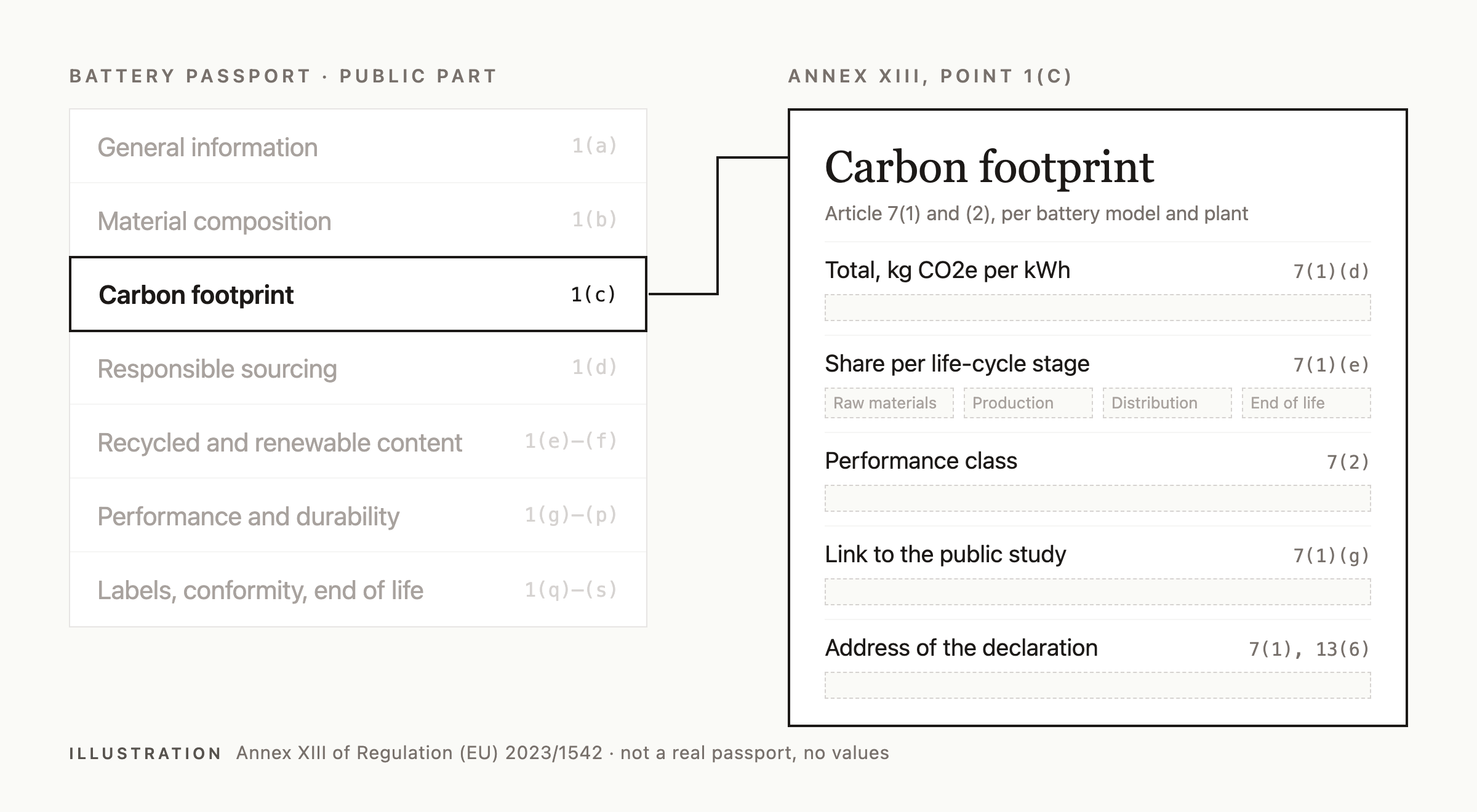
From 18 February 2027, each LMT battery, industrial battery above 2 kWh and EV battery placed on the market needs a battery passport (Article 77(1)). Annex XIII, point 1(c), puts "the carbon footprint information referred to in Article 7(1) and (2)" in the part of the passport that is accessible to the public.
The illustration at the top of this article shows that block:
- the carbon footprint in kg CO2e per kWh, Article 7(1)(d)
- the share per life-cycle stage, Article 7(1)(e)
- the performance class, Article 7(2)
- the link to the public study, Article 7(1)(g)
- the address of the declaration, reached through the QR code, Article 13(6)
Article 77(2) includes the information "to the extent applicable" to the battery. Until the obligation starts there is nothing to show, but the passport needs the place for it. The DPP Academy episode on who sees what covers the public and restricted layers.
The carbon footprint is checked by a notified body: Article 17(2) requires Module D1 for batteries made in series, or Module G otherwise.
How the carbon footprint is calculated
Annex II sets the essential elements the Commission's methodology has to build on. It must follow the latest Product Environmental Footprint (PEF) method and the relevant Product Environmental Footprint Category Rules (PEFCRs).
Functional unit, life-cycle stages and data models (Annex II)
Functional unit. One kWh of the total energy the battery provides over its service life: cycles multiplied by the energy per cycle. Back-up batteries use one kWmin of backup power capability.
Reference flow. Kg of battery per kWh of total energy delivered over the service life.
System boundary. Annex II, point 4, includes four life-cycle stages:
| Life-cycle stage | What it covers |
|---|---|
| Raw material acquisition and pre-processing | Mining, sourcing, pre-processing and transport of materials, up to the manufacture of cells and components |
| Main product production | Assembly of cells, and of batteries from cells and electronic components |
| Distribution | Transport to the point of sale |
| End of life and recycling | Collection, dismantling and recycling |
The use phase is excluded unless the manufacturer's design choices are shown to have a non-negligible effect on it. Cathode materials and electronic components such as battery management units "shall be accurately identified, as they can become the main contributor" to the footprint.
Data models. The CIRPASS-2 draft battery ontology (version 0.1.1, updated 26 October 2026) links the battery to an LCA study whose result is the carbon footprint. It is exploratory, not official, but matches point (g): keep the figure, the stage split and the study together.
What to prepare now
- List every battery model in scope per manufacturing plant. Each pair is one declaration.
- Collect bill of materials, energy and auxiliary materials per plant, plus service life and energy per cycle.
- Keep results split into the four Annex II life-cycle stages.
- Prepare a public version of the study and a stable web address for it.
- Plan the Module D1 or Module G assessment with a notified body.
- Reserve the carbon footprint fields in the passport and test a draft with the DPP validator.
The DPP Academy episode on batteries covers the rest of the battery passport.
Frequently asked questions
When is the battery carbon footprint declaration mandatory?
Each date in Article 7(1) of Regulation (EU) 2023/1542 is a fixed date or 12 or 18 months after the Commission's methodology and format acts enter into force, whichever is later. On 27 October 2026 neither act has been adopted, so it is not yet mandatory for any battery.
Which batteries need a carbon footprint declaration?
Electric vehicle batteries, rechargeable industrial batteries above 2 kWh and LMT batteries, one per battery model per manufacturing plant. Portable and SLI batteries are not covered.
What unit is the battery carbon footprint declared in?
Kilograms of CO2 equivalent per kWh of the total energy the battery provides over its expected service life. Back-up batteries use one kWmin of backup power capability instead.
Is the carbon footprint public in the battery passport?
Yes. Annex XIII, point 1(c), lists the carbon footprint information from Article 7(1) and (2) among the passport data accessible to the public.
Can a manufacturer self-certify the carbon footprint?
No. Article 17(2) requires Module D1 or Module G, both of which involve a notified body.
Sources
- Regulation (EU) 2023/1542 (Battery Regulation): Article 7 (carbon footprint), Article 13(6) (QR code), Article 17(2) (conformity assessment), Article 77 (battery passport), Annex II (carbon footprint calculation), Annex VIII (Modules D1 and G), Annex XIII point 1 (public passport information). EUR-Lex
- European Commission, Have Your Say: Carbon footprint methodology for electric vehicle batteries · Format of the carbon footprint declaration for batteries · Carbon footprint methodology for industrial batteries · Carbon footprint label classes for electric vehicle batteries
- Publications Office of the EU: Draft Commission Delegated Regulation on the carbon footprint methodology for electric vehicle batteries, Ares(2024)3131389
- CIRPASS-2: Battery ontology, including the carbon footprint SHACL shapes (draft, Apache 2.0)