Naturvårdsverket and Digital Product Passports: Its Role
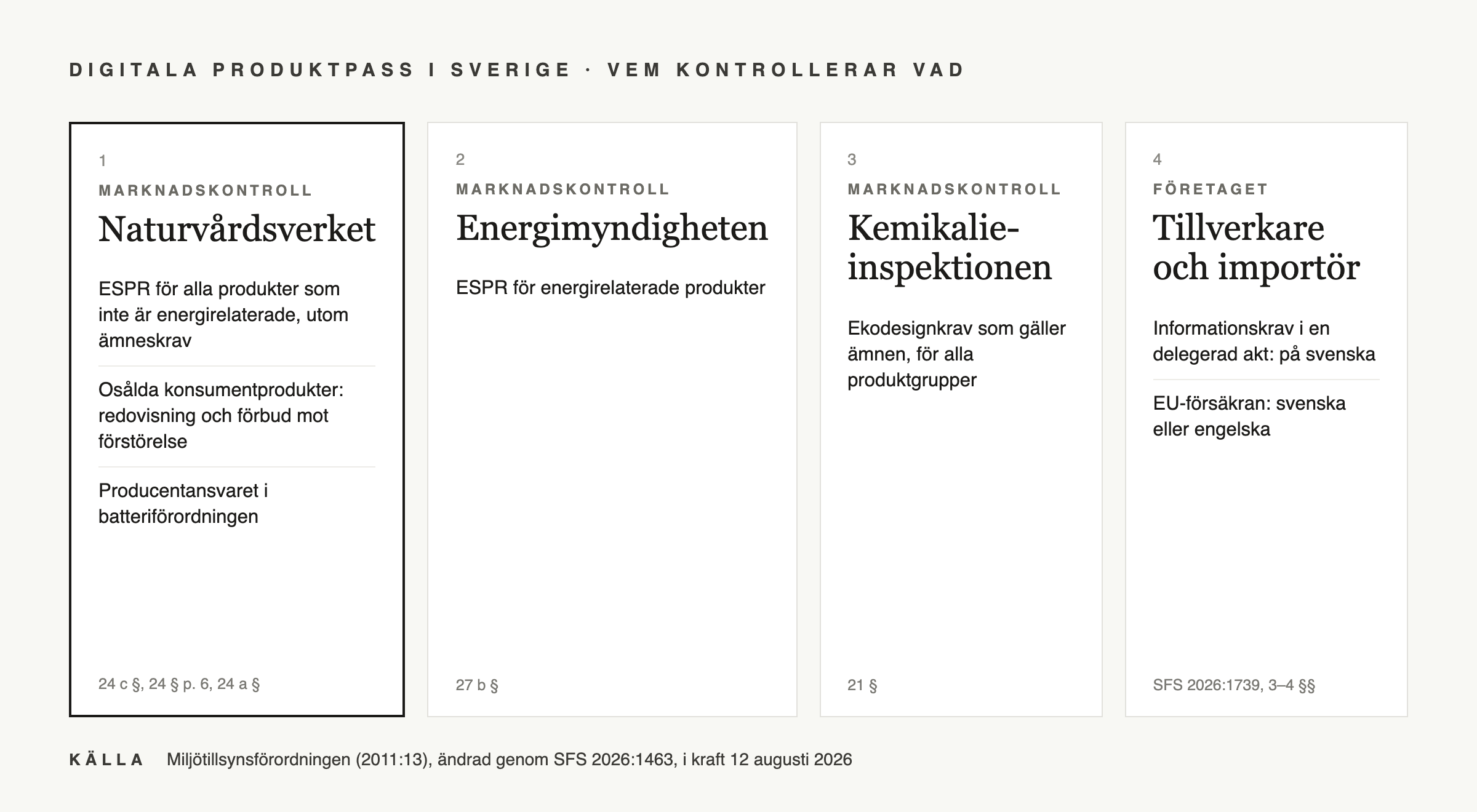
Naturvårdsverket, the Swedish Environmental Protection Agency, is the authority that checks that products on the Swedish market comply with the EU Ecodesign Regulation (EU) 2024/1781, ESPR, and so with its digital product passport requirements. This follows from section 24 c of the Swedish Environmental Supervision Ordinance (miljötillsynsförordningen), in force since 12 August 2026 (SFS 2026:1463). There are two exceptions: the Swedish Energy Agency checks energy-related products and the Swedish Chemicals Agency checks ecodesign requirements on substances. Since 29 September 2026, Ordinance (2026:1739) also requires the information a delegated act asks for to be available in Swedish.
No product group yet has a mandatory digital product passport under ESPR. The requirements come in delegated acts, and the first is expected for iron and steel or textiles. But who checks, and in which language the passport must be, is already decided.
What does Naturvårdsverket do with digital product passports?
The agency has three roles that concern product passports.
1. Market surveillance under ESPR
Under section 24 c of the Environmental Supervision Ordinance, Naturvårdsverket is a market surveillance authority and carries out controls under the Market Surveillance Regulation (EU) 2019/1020 on whether products comply with Regulation (EU) 2024/1781. The section was introduced by Ordinance (2026:1463), issued on 25 June 2026, and entered into force on 12 August 2026.
ESPR says that a product covered by a delegated act may only be placed on the market if a digital product passport exists for it (Article 9). Whoever checks the ecodesign requirements therefore also checks that the passport exists and holds what the act requires.
2. Supervision of unsold consumer products
Under section 24, point 6, of the Environmental Supervision Ordinance, Naturvårdsverket supervises the obligations of economic operators under Articles 24(1), 25(1) and 25(2) of ESPR. These are the annual disclosure of discarded unsold consumer products and the ban on destroying unsold apparel and footwear. The ban applies from 19 July 2026. Micro and small enterprises are exempt, and for medium-sized enterprises it applies from 19 July 2030, according to the government memorandum.
3. Guidance and the work in the EU
Naturvårdsverket has a page on ESPR covering the digital product passport requirement, the Commission's working plan and the consultations under way. The page also hosts the Commission's document "Digital Product Passport: Frequently Asked Questions (FAQ)", version 1.0.
According to the government memorandum of 19 September 2025, Naturvårdsverket, the Swedish Energy Agency, the Swedish Chemicals Agency, the National Agency for Public Procurement and Swedac prepare Sweden's positions when the Commission's proposals are discussed in the Ecodesign Forum and its Member State expert group. The task was set in the agencies' appropriation directions for 2025.
Who checks what?
Responsibility is split by product group, with one exception for substances that applies to every group.
| Authority | Responsibility under ESPR | Provision |
|---|---|---|
| Naturvårdsverket | Market surveillance of all products that are not energy-related, except substance requirements | Section 24 c, Environmental Supervision Ordinance |
| Naturvårdsverket | Supervision of disclosure on, and the ban on destroying, unsold consumer products (Articles 24(1), 25(1), 25(2)) | Section 24, point 6, Environmental Supervision Ordinance |
| Swedish Energy Agency | Market surveillance of energy-related products | Section 27 b, Environmental Supervision Ordinance |
| Swedish Chemicals Agency | Ecodesign requirements on substances, for every product group | Section 21, Environmental Supervision Ordinance |
For the product groups in the Commission's working plan, this means textiles, tyres, furniture, mattresses, iron and steel and aluminium fall to Naturvårdsverket, while the substance requirements in the same acts are checked by the Swedish Chemicals Agency. The memorandum grounds the split in Naturvårdsverket's knowledge of the aspects ecodesign requirements are meant to improve, such as reusability, material recycling and climate footprint.
Does the product passport have to be in Swedish?
Yes, for the information a delegated act requires. Ordinance (2026:1739) supplementing the EU Ecodesign Regulation, issued on 27 August 2026 and in force since 29 September 2026, says in section 3:
Information to be provided under the information requirements of a delegated act adopted on the basis of Articles 4 and 7 of the EU Ecodesign Regulation shall be in Swedish.
According to Naturvårdsverket, the digital product passport is how the information requirements are packaged. A passport for a product sold in Sweden therefore needs to be readable in Swedish. A passport that exists only in English does not meet the requirement, even though the EU declaration of conformity may be in Swedish or English under section 4.
For a brand selling in several countries, the simplest route is to have the translation in the passport from the start, with the same data and one language per market.
When do the requirements apply?
No digital product passport is yet mandatory under ESPR. The requirements apply only once the Commission has adopted a delegated act for the product group, and as a rule the application may not start earlier than 18 months after the act enters into force (Article 4(4)).
The Commission's working plan for 2025–2030 (COM(2025) 187), which Naturvårdsverket reproduces, gives the expected adoption dates:
| Product group | Type | Expected adoption |
|---|---|---|
| Iron and steel | Intermediate product | 2026/2027 |
| Textiles and apparel | Final product | 2027 |
| Tyres | Final product | 2027 |
| Reparability | Horizontal requirement | 2027 |
| Aluminium | Intermediate product | 2028 |
| Furniture | Final product | 2028 |
| Mattresses | Final product | 2029 |
| Recyclability of electronics | Horizontal requirement | 2029 |
Batteries follow a regulation of their own. The Battery Regulation (EU) 2023/1542 requires a battery passport from 18 February 2027 for LMT batteries, industrial batteries above 2 kWh and electric vehicle batteries (Article 77(1)). Portable and SLI batteries are not covered. Under section 24 a of the Environmental Supervision Ordinance, Naturvårdsverket supervises the producer obligations in the Battery Regulation. More in EU Battery Passport: Requirements and Deadlines.
The full timeline is in ESPR Compliance Timeline.
Who in the company is responsible for the passport?
According to Naturvårdsverket, the manufacturer is responsible for the product passport if the product is made in the EU, and the importer if it is made outside the EU. Where the act requires it, the product must carry a clearly visible label with a QR code leading to the passport, and it must be visible in distance selling too. Customs checks certain passport data on import.
ESPR lists six economic operators with obligations of their own, including the dealer, who must make the passport easy for the customer to reach. Who they are and what each must do is in Six Economic Operators, Not Four.
What Naturvårdsverket has said about battery passports and product passports
In a response of 11 September 2025 to the Commission's omnibus proposal on digitalisation, Naturvårdsverket welcomes documents being provided digitally. At the same time it points to two things. The requirements for battery passports in the Battery Regulation and for product passports in ESPR are not identical, which can create particular challenges. And if a battery is removed from an electrical product, the QR code becomes inaccessible, so the proposal should be supplemented with how the information can be reached without a QR code.
For anyone building passports for both batteries and other products, this means the data model has to handle both regulations, and the link between the battery's passport and the product's passport cannot rely on a label alone.
What a Swedish company can do now
- Find out which authority applies to your products. Energy-related product: the Swedish Energy Agency. Otherwise Naturvårdsverket, and the Swedish Chemicals Agency for substance requirements.
- Plan for Swedish. The information a delegated act requires must be in Swedish under Ordinance (2026:1739).
- Follow the working plan for your product group. Allow at least 18 months from an act entering into force to its application.
- Check apparel and footwear. The ban on destroying unsold apparel and footwear already applies to large companies, and Naturvårdsverket supervises it.
- Test the passports you already have. The validator checks a passport against the EN standards and the ESPR baseline fields, and DPP Academy walks through the requirements step by step. The background to the regulation is in ESPR Explained.
Frequently asked questions
Which authority checks digital product passports in Sweden?
Naturvårdsverket is the market surveillance authority for ESPR under section 24 c of the Environmental Supervision Ordinance, since 12 August 2026. The Swedish Energy Agency checks energy-related products (section 27 b) and the Swedish Chemicals Agency ecodesign requirements on substances (section 21).
Are digital product passports mandatory in Sweden today?
Not under ESPR. The passport becomes mandatory for a product group once the Commission has adopted a delegated act for it and the application date has passed. Battery passports under the Battery Regulation are required from 18 February 2027 for LMT batteries, industrial batteries above 2 kWh and electric vehicle batteries.
Does a digital product passport have to be in Swedish?
The information a delegated act requires must be in Swedish, under section 3 of Ordinance (2026:1739), in force since 29 September 2026. The EU declaration of conformity may be in Swedish or English.
Who enforces the ban on destroying unsold apparel?
Naturvårdsverket supervises Articles 24(1), 25(1) and 25(2) of ESPR, under section 24, point 6, of the Environmental Supervision Ordinance. The ban on destroying unsold apparel and footwear applies from 19 July 2026, with micro and small enterprises exempt.
Where can I find Naturvårdsverket's information on product passports?
On the agency's page on the EU Ecodesign for Sustainable Products Regulation (ESPR), which also hosts the Commission's FAQ on digital product passports.
Sources
- Environmental Supervision Ordinance (2011:13): sections 21, 24 point 6, 24 a, 24 c and 27 b, amended by Ordinance (2026:1463), issued 25 June 2026, in force 12 August 2026. Riksdagen · SFS 2026:1463
- Ordinance (2026:1739) supplementing the EU Ecodesign Regulation: sections 3 and 4, issued 27 August 2026, in force 29 September 2026. SFS 2026:1739
- Ministry of Climate and Enterprise, memorandum Supplementary provisions to the EU Ecodesign Regulation, KN 2025/01772, 19 September 2025: sections 4.7, 6.1 and 6.3. Government Offices
- Naturvårdsverket, EU-förordningen om ekodesign för hållbara produkter (ESPR), reviewed 18 August 2026. Naturvårdsverket
- Naturvårdsverket, response on omnibus IV, digitalisation and common specifications, 11 September 2025. Naturvårdsverket
- Regulation (EU) 2024/1781 (ESPR): Articles 4(4), 9, 24 and 25. EUR-Lex
- European Commission, Ecodesign for Sustainable Products and Energy Labelling Working Plan 2025–2030, COM(2025) 187. EUR-Lex
- Regulation (EU) 2023/1542 (Battery Regulation): Article 77(1). EUR-Lex